Showing posts with label Fronts. Show all posts

Happy New Year!


Hello all, well I know it's been quite some time since the last blog post, and I do apologize, but my new job took on way more responsibility than I originally thought.  With that being said I plan on getting right back to where we were with the Five Spoke Secondary posts.  So stay tuned all as things should get back to normal around here, at least until next fall!


Schematic Musings from 2015

Just some general notes about some things I saw this past season, both where I coach and in college and the NFL.  First off, the number one thing I noticed this past season was a MAJOR resurgence in gap schemes from the spread offenses.  This may have simply been one back power, or inverted veer all the way to buck sweep from the shotgun.  No matter, the number of teams we faced that ran zone schemes, diminished greatly from the previous season's data (2014).  Gap runs are now in vogue in the world of college football, and the trickle down effect is in full swing.

Expect to see more and more of runs like this...

The one thing, at least where I'm at that hasn't really taken off too greatly is that off the Run Pass Option plays or RPO's.  We saw only two teams this past season, in which we played 13 games, that attempted to run RPO's.  Of those two teams, neither did, what I would call "majoring" in RPO's, but more "dabbled" in them.  We saw some packaged screens, and some quick passing off of these looks, but not much other than that, and to be honest, both teams, despite being talented, weren't very good at executing these plays.  I do, however, fully expect the onslaught of these packaged plays to become more and more prevalent the further we travel down football's timeline.

On the collegiate front, It was extremely neat to watch the evolution of Kirby Smart and Nick Saban's defense at Alabama this past season.  Yes, Ole Miss beat them, with the EXACT formula that has been Saban's kryptonite over the past few seasons, however you can see a shift in the thought process at Alabama on several fronts.  The beginning of this swing, was the addition of Lane Kiffin as the offensive coordinator last season .  By adding Kiffin, and bringing in his mind of RPO's and up-tempo offense, it has actually gone so far as to make the defense better.  No longer is an old-school, 3 yards and a cloud of dust, huddle and repeat offense trying to learn up-tempo to give the defense a look.  No, up-tempo is a style of play at Alabama now.  Yes, I know Saban wanted to ban the no-huddle a few years ago, but he's seen the future of college football, and he's done what all the great one's do and that's adapt.  Not to get to schematic with things, here's my list of Saban's adaptations into the "modern era" of college football.


  • The no-huddle up-tempo.  Yes, just what I mentioned above.  His team is now able to mimic these offenses, because up-tempo is in part, what Kiffin likes to do on offense.  Yes, they aren't Auburn, Oregon or Baylor, but they do use tempo as a key part of their offensive identity, which breeds familiarity.  This allows them to give their own defense a good solid look in practice at what they will see during game week.  These looks, being as close to game speed as possible is critical to the defense's success.  
  • I'm sure it wasn't all Kiffin though.  Saban and Smart had to make a dedicated effort to want to change.  In other words, they had to be willing to adapt or mold their philosophy.  One change I saw, was in the secondary.  They both were more willing to drop the larger, run stuffing style of safety Saban has typically employed over the years at that position, for more "cornerback" types there.  Saban and Smart finally realized getting more speed on the field was paramount.  One area that is very difficult to run in sub packages is the secondary.  You need consistency there, and those two found a way to keep the same four guys on the field at all times.
  • They practiced subbing in their various packages against themselves.  Saban hasn't fully washed his hands of personnel groups.  What they have done is figure out a way to use the substitution rule to their advantage.  I read one article where a player said it was "organized chaos" on the sidelines.  What he later went on to say, is that when he first arrived at Alabama...it was just "chaos".  This means there has been improvement in the sideline management of getting the right players on the field at the right time.  The other element, is the size of the sub package.  When watching the National Championship game this past Monday night, I would see no more than three guys at a time run on the field, and usually it was just one player.  This means that they are recruiting players who can stay on the field and help in any situation, something I also think is very key in defending these type of tempo, spread offenses.
  • One key area Saban has upgraded, is special teams.  I cannot, for the life of me, figure out how a guy like Nick Saban got where he is, with such a poor special teams philosophy.  I've never known Saban to have a punter you would consider a "weapon", but I don't know how many times I heard Alabaman punter J.K. Scott mentioned as just that...a weapon.  The same can be said of Alabama's kicker.  Despite missing a field goal in the game this past Monday night, Alabama's kicker has been on point for most of the season.  The other thing is, he kicked a perfectly executed pooch-style onside kick.  I'm not sure in years past if I've ever seen a better special teams unit under Nick Saban.  Special teams, in my opinion, is an area that against the modern spread, up-tempo offenses, where you can gain the advantage by stealing a possession.  Fake punts, onside kicks, and fake field goals are things that have to be done in practice, to a high degree of repetition in order to insure success.  I think this mental shift was none more evident than in the National Championship game by Clemson keeping Alabama's punt block unit at bay with the threat of the fake, and Alabama's critical onside kick.  One was simply just the "threat" of a stolen possession, and the other WAS a stolen possession.  See these offenses are going to score points.  If the idea is to score more, then you need to find a way, at the end of the game, to have had more scoring opportunities than your opponent.  Stealing possessions on special teams is a great way to do this, but most coaches don't put in the time to do so.  This is where I think many coaches are going to have to make their philosophical changes to their approach to the game.


Some other things I've seen, or been thinking about when it comes to defense in the modern age of football is that of the evolution of defenses.  So many teams out there play so many fronts now, it's hard to really say what they truly are anymore.  When watching the National Championship game, one could argue Alabama stayed largely in a 4-2-5 alignment.  I've watched plenty of TCU cutups from the past two seasons, and it looks like they are running a 3-4 scheme at times.  What I think is increasingly becoming en-vogue is splitting the field and covering each half differently.  Whether it be with two types of zone concepts, or whether it be with man-to-man on one side and zone on the other, teams are rarely staying in "pure" coverages anymore.  Setting the coverage to work with the front is also becoming increasingly popular, as we all know in some cases when in man, the secondary cannot effectively provide run support, so now it must fall on the front to do so.  I've seen teams that were typically even front teams with secondary run support, morph into more of an odd front to the man side of their coverage and allowing the front (an end or a linebacker usually) to be the dedicated force player.  Concepts such as this are what is going to get the defenses back into the fold when it comes to modern day football.  

What I think is becoming increasingly an issue is exactly what we saw in the playoffs this season.  In our regular season, we faced eight spread offenses and two pro style offenses in our 10 game regular season.  That means we were pretty geared up to stop the spread.  In the first three rounds of the playoffs, we were facing either Pro style or Wing-T.  It took our kids a bit to remember how to "fit" back into the box, and luckily for us we have some great coaches that were able to get this done, but you could see at times it caused some issues.  We don't sub, so keeping the same 11 out there against the various offenses can get to be a challenge.  The issue is, what to do when you see that one Flexbone, or Wing-T, or Pro I team on your schedule.  I think mixing in periods of practice against these styles of offense throughout the season would be a big help.  Using the bye weeks and spring/summer practices to defend against the option is something I've done since as early as 2005.  It's a great way to keep your fits honed vs. offenses you might not see all the time.  


Anyhow, that's my ramblings for 2015.  It was a great year for me changing jobs and getting to work with a great staff.  I look forward to the upcoming season and the rebuilding job we have in front of us.  For now though, I'll get back to blogging!

Duece

Creating an Eight Man Front to Defend the Spread Offense-II


The drink of all eight man front coaches!
In the first post, I gave you a brief history on the defense my staff and I developed out of the 4-2-5  personnel to defend a schedule, heavily laden with spread offenses.  In this post, I'm going to talk about our match up issues and what we did to alleviate these issues to help with being able to compete against vastly superior athletes.  Now this isn't to say we were successful, however, the ideas that were learned through a season of innovation, I think, are worth sharing.

Force Issues
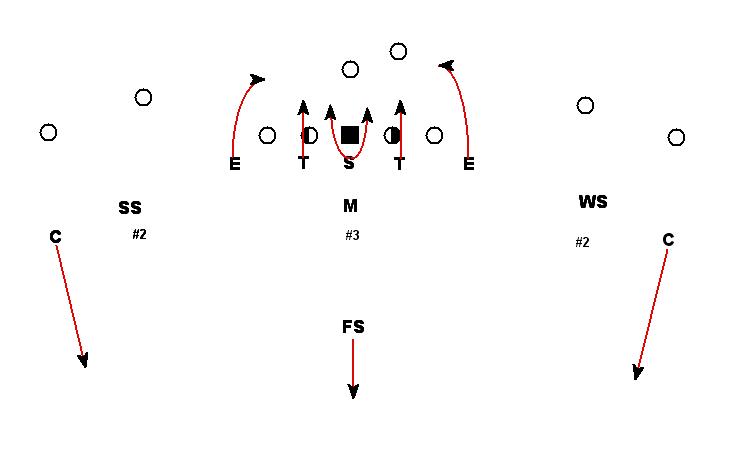
Rip/Liz cover three is a great adaptation to defending the spread offense, but does have one drawback, and that is that your force player is responsible for the vertical of the number two receiver.  But Duece, that's no different than in any Quarters coverage scheme, so what's the big deal???  The big deal is the Quarters coverage force player is doing this from a depth of eight to 12 yards.  In the eight man front, with a one high safety look, these players are doing their job from an invert depth of five yards off the LOS.  This means that these players, must make their reads very quickly.  The other issue, is that the outside safeties (OSS's) must align in outside leverage on the number two receiver, which means they can be out leveraged to be able to engage in their role as the force player.


SS has a long way to go to force the ball, but must also handle the vertical of #2


The way my staff and I handled this issue, was in a couple of ways.  The first thing we did was not to change anything but the way our defensive line (DL) would play, a topic that we've already talked about, the Two-Gap/One-Gap scheme better known as TGOG.  We would set the three technique to the field, so that the DE to the field side would be a one-gap player, thereby having him come up field hard and "box in" the play. 


This technique serves us well on inside runs that spill outside, however, the jet sweep killed it, and we had to do something else.  I looked high and low, and came up with two solutions, the first was to align the tackles in double 2I techniques, and the ends in five techniques.  Utilizing TGOG principles, this meant the tackles were one gap players and the DE's were two gap players.  By doing this, we were able to move our LB's out to a "hip" alignment stacked behind the DE's which allowed them to "fit" better on outside run plays. 


Now even though the LB is not the force player, by making taking away any reads he has and forcing his "flow to" read to be an automatic C gap fit, the offense is not in a position to block this player very well.  Even if they lead the back, the LB will allow the WS (in the diagram above) to get his read, come off any block that may occur and force.  Ok, I know, what the heck do you do with the inside run game, as those B gaps sure to look inviting.  Remember, utilizing the TGOG principle, makes things seem as though they aren't!


Another thing we did to add confusion was the 3-3 stack front talked about earlier, and we simply had the DE's play the two gap responsiblility and had the two tackles attack the A gaps in tandem based on our call. 


As you can see, the idea was to alleviate the immediate pressure on the force player by putting the LB's in a position to support the C gap immediately.  However, our defense against the run was less than successful that season.  It was not the outside run that hurt us as much as the inside run, and it had little to do with scheme, as we once again saw a weakness in our match ups.  Teams really hurt us with a good running quarterback and running isolation and power run plays.  Desperately seeking a solution, one presented itself via the Huey board in the form of an old defense, made popular by Buddy Ryan...yep, the 46!


Defending the Inside Run
Now, the 46 Nickel was something that was born out of this, but how I actually got in the 46 was very interesting.  At first, the idea was to simply have the tackles align in three techniques and be one gap players as well as letting the DE's align in wide nine techniques and also play a one-gap technique.  The strong side LB would walk down and stand over the nose while the weak side LB stacked behind as shown below:


We did several things out of this.  The first was have the Sam read the hat of the center, and go to the opposite A gap if the center tried to cut him off.    This allowed the Mike to scrape to the play, virtually unblocked.  Coverage wise, the Sam would always drop to the short side of the field if he got a high hat read, and Mike would drop to the wide side of the field.  If the ball was in the MOF, then the Sam dropped left and the Mike to the right.


The other great thing about this was we could rush the Sam, play cover six (three deep three under fire zone) and have the Mike be the three dropper quite easily.  Another less expected result was to bring the Mike, and drop the Sam, all the while playing a fire zone coverage behind it.


Sam rushed based on call (strong/weak/right/left), Mike responsible for A gap away from call


Bringing Mike and dropping Sam yielded some good results!

The fire zone coverage was an easy install because relatively little changed for the underneath droppers.  The only changes were that to the weak side or the short side, these defenders would play pure man to man defense.  On the strong side, or wide side of the defense we used fire zone principles with a true number two dropper (SS) and a number three dropper (Mike/Sam-whoever dropped).  So the final outcome would look like the illustration below:


Because of our athleticism at DE, we eventually went pure cover one for simplicity's sake.  As you can clearly see, you can run the fire zone concept from this look quite easily. 

The three, zero, three alignment freed up our LB's to play the run so much better because it eliminated the double teams that are present when you leave two gaps open instead of one.  Once this was installed teams really struggled to run on us. We did give up some passes across the middle, and we began mixing in some cover one.  We could do this because of the wide DE's as we could use them to force now. 

A lot of folks would argue, "Duece you are no longer really a 4-2 anymore!", to which I would say, no we are, we just had to use some tricks to make things work better for us in areas where we did not match up very well.  I think this is the goal of any good coach, as the idea that you must "stick to the scheme" will eventually get you fired.  Adaptation and teaching are what are traits of all good football coaches.  This ability to "make the parts work" is essential in finding success.  For us, the schemes shown above took a defense that was giving up an average of 450 yards per game of total offense and allowed us to reduce that number to around 240 yards per game.  Still not great, but the schemes helped to stop the bleeding.  I know, scheme isn't everything, but when you are teaching the players correctly, and their God given abilities are failing them, you have to try to find ways around these deficiencies to try and find success.  These schemes did just that.


In the last post, I'm going to discuss the role of the free safety (FS) in making the eight man front successful against the spread.  I hope you find these post insightful as you do your off season homework.  Remember champions are not made overnight!


Duece

An Interesting Twist on Defensive Line Play in the Four Man Front


I recently had the privilege to sit down with a colleague of mine and share some thoughts about defensive line (DL) play in the four man front.  Both of us have very similar philosophies when it comes to the "big uglies" up front...LET EM' PLAY.  However, we also both agree that a DL cannot just be a loose cannon either.  So we discussed at length what our DL reads, and DL play was about and came to a very startling conclusion.  That is the purpose of this article, is to discuss several aspects of DL play, and how us as coaches can alleviate some pressure off of our DL by using simple rule changes to how we defend our opponents blocking schemes.  I think in the end you will be pleased with our findings, and these findings will actually help speed up your linebackers (LB's) as well.

The Big Four
I have always been a proponent of teaching the "big four" block reactions.  These are as follows:
  1. Base block
  2. Reach block
  3. Down block
  4. Pass pro block (high hat read)
As I was taught, here is how the DL should react to all of the following blocks.
  1. Base- DL should attack the V of the neck and fight pressure with pressure looking to collapse the offensive lineman (OL) back into the gap to the inside.
  2. Reach- DL works laterally to maintain gap integrity and still fights pressure with pressure, but this time in an attempt to not have his outside shoulder reached.
  3. Down- DL gets hands on the blocker and mashes blocker down into gap to the inside, and then plays down the line to up the field read looking to:
    1. Spill the first puller (trap)
    2. Spill the kick out block (power)
    3. Tackle the ball carrier (veer/midline)
  4. Pass- DL works up field in his rush lane and makes a move to attempt to sack the quarterback (QB).


Defeating the base block the traditional way

Defeating reach blocking

Wrong arming the trap block

I know these are generic ways of teaching the technique, but you basically understand what I was teaching to my DL.  Now let's look at a little history on how my colleague and I arrived at our DL philosophies.

History of DL Play
In my early years, wrong arming was the new wave of things, and the "big four" reads above were just being taught.  I remember sitting in clinics thinking of how simple and sound this stuff was compared to the old DL reads I'd been teaching in the 50 defense (yes, I was an odd front guy, many moons ago, but not by choice).  Anyhow, my defensive coordinator at the time was switching to the 4-3, and all of this made sense and really came into play.  We put teams on their ears as they did not know what to do with this new DL technique.  Wrong arming was especially tough on our opponents.  Back then we taught one-for-one and had our lineman cut any pullers they came up against (we were taught that way back then).  Later on we changed this to "running the circle" and getting a two-for-one advantage. 

Then comes the spread!  Well, being a 4-3 Quarters guy, there were several times we were left with a 4-1 box and had to something to alleviate some pressure on middle linebacker (MLB).  At first we simply ran a stunt we had in our base package called "knife".  The knife stunt simply told the defensive end (DE) to slant one gap inside his normal alignment.  This worked good until you ran up against a QB who could scramble.  The QB simple rolled outside  your DE that had pinched and had no pressure in his face now.  So we came up with a way to keep our base reads, but change the ones that were giving us trouble, by creating a stunt we called "Ed".  Ed stands, for end down and has been talked about in many of my defending flexbone posts.  Basically the "big four" reads remain the same, except for that of the base block.  In the Ed stunt, I had the DL wrong arm the base block, thereby putting them down one gap inside their normal alignment.  It was accomplishing the same thing the knife stunt was, but now on a pass protection read, the DL used the same technique we normally taught and was able to still contain the QB.  Later on, we added the "TED" stunt, which stood for tackle and end down, meaning that both the tackle and the DE's were going to wrong arm any base block they got.  The TED stunt was very good against the midline and counter iso plays I was seeing at the time from some of our flexbone opponents.


Ed stunt vs. base block

I have used the Ted and Ed stunts on and off for the past seven years, with a great deal of success.  We also used these stunts to help protect what some would call, less-than-adequate LB's as well.  These were LB's who could not meet the isolation play consistently at or around the line of scrimmage (LOS), for whatever reason (fear, inability, athleticism, etc.).  The stunt took away the inside gap that was being opened and spilled the ball outside where our lesser players could simply run it down.  The stunt and technique, coupled with safety run support, made for a very sound scheme, even when I didn't have a great corps of LB's. 


Ed stunt protecting OLB

Which leads me to the next historical point of my friend and his conversation with his DL coach a few years back.  Due to his request I will leave my friend and where he coaches out of this, but a few years back he and his DL coach were having a conversation in a defensive team meeting, when they noticed a weak kid they had at DE getting reached constantly.  The young man did good on traps and spilling the puller, and was a pretty good pass rusher as well.  The young man simply could not handle the reach block.  So my friend asked his coach, in preparation for an upcoming playoff game, "Will he get reached?".  To which the DL coach said "yes".  Anyhow, they lost the playoff game (not because of the DE, obviously), and in the off-season, my friend headed out in search of an answer to his troubles.  What my friend looked for were colleges that consistently did not get quite the same talent as those around them, or in their conference, yet were very competitive year in and year out.  Again, for anonymity I will not disclose where he found this technique, but the funny thing is, I had been doing some of it and never even knew it.


This technique is simply known to us as "Two-gap, one gap", and is probably not as revolutionary as some think, however in discussing this with coaches I find not many use this technique.  To look at how things work with the TGOG system, let's take a look at just what the scheme is from the ground up.

The Basic Scheme
The basic TGOG system is very simple.  There will be two one gap linemen, and two two gap linemen in the four down lineman system.  There will also be one of these to each side, so that the defense has a two gapper, and a one gapper on each side of the football.  Now let's look at how you determine which DL play which technique.

The simplicity of the system lies in the lack of specialization.  I used to be a coach that every player had to have a "special" job or quality, but have quickly found out that this leads to a large teaching problem.  Specialization, though it sounds cool, can and will frustrate you as a coach.  The more generic you can be with your coaching, the more you can accomplish with your players.  This is the old triple option coaches axiom of "Multiplicity through simplicity".  In DL terms, this means having two ends and two tackles, not a strong end, weak end, nose and tackle.  Both the tackles and ends should be interchangeable meaning that these players should be able to play both the strong and weak sides of a formation equally.

Ok, so now that the lack of specialization has been addressed, we can now focus on the first part of playing DL, alignment.  The alignment in the TGOG system is very important.  The one gap lineman aligns in a "looser than normal" alignment.  So for the DE, this would mean that if he were to normally align in a five technique, he would align in a seven technique (even if there wasn't a tight end present).  The two gap lineman aligns very tight, almost head up on the OL.  So if a DE were to be in a five technique he would align with his nose on the outside eye of the offensive tackle (OT).  The reasons for this variation in alignment, will be discussed later.


The way the TGOG system works is very simple.  For the interior linemen, if you are in a two technique or higher, you two-gap.  If you are in a two-eye technique or lower, then you one-gap.  So, in our base over front, the weakside tackle is in a one technique and he is a one gapper, meaning he will more than likely align in the A gap (wider than a normal one technique) and is only responsible for the A gap, getting upfield and wrecking havoc.  On the strong side the strong tackle is in a three technique, so he is a two-gapper.  The two-gapper will align much tighter than a normal three technique and will utilize the two-gap technique.  All the DE's have to do is ask themselves this simple question "Is the gap inside of my alignment vacant or occupied (you can use open or closed either one will suffice).  If the gap is open, then the DE is a two-gapper.  However, if the gap is closed, then the DE is a one-gapper (as shown above).


The one gap lineman is quite simply summed up in one phrase...pass rusher.  When you coach the one gap lineman the main goal is to get off the football, get up field and disrupt blocking schemes via penetration.  Now I know many of you die-hards are going "Oh yeah, well I'll just trap your ass".  Well, it isn't quite that easy, however that is the main focus of coaching the one gap player.  The one gap player should avoid blocks, and get up the field.  If the player is the one technique, think penetration and disruption.  The DE is simply turned loose, and allowed to rush around the corner.  Now I know what you are thinking, however there are block reactions.

The one gap DL is very simply put, to maintain the gap they are aligned in.  The reaction to the base, reach and pass set are all the same, get up field and rush around the corner.  The only thing that changes on the down block, is the angle of attack that the DL will take to the football.  When the OL down blocks, the one gap DL will get into "chase" mode and come flat down the LOS.  It does not matter how the one-gapper handles the trap block.  When in doubt, he is to spill if he can, however if he boxes, this is not a problem either.  That is the beauty of the system, let the one-gappers go and wreck havoc.  That's it!  The one gap technique is very aggressive and very simple, which allows you to teach both the one gap and two gap techniques to your DL.


1 gap DE reaction to base, reach and pass set


1 gap DE reaction to down block (chase)

The two gapper, is also every bit as simple as the one gapper.  The two gapper is only a two gapper on paper, meaning he aligns in one gap, but is responsible for another.  When coaching the two gap DL, think King of the Boards drill.  The two gapper is in KOB mode all the time.  The reason for this is simple, in the KOB drill, there is no advantage to either side, it is simply put, man-on-man, may the best man win.  In a game situation however, OL have to react to stunts and movements by the DL to maintain leverage.  Even zone teams, will anticipate certain movements or reactions from DL aligned in certain techniques.  Basically, OL in game situations are more tentative than they are in KOB drills.  The DL however, knowing what he has to do (basically bull rush), is clearly at the advantage.  No matter what the OL does, the DL's job is to drive this defender backwards.  The DL is actually assigned to the gap inside his alignment because of this technique.  So against the base, reach and pass set, the DL will bull rush directly at the OL he aligns over.  Once the block is read, contact is made and the OL driven back the DL will then slip into the inside gap.  Against the down block scheme the DL is still trying to mash the OL back, but will now mash him down inside, thereby physically placing himself looking down the line into either the path of the puller, or the running back.  The key element for two gap players is contact and hands.  Two gappers must always get hands on the OL.  The two gapper cannot run around or avoid blocks, yet he must run through them, at least through contact, before getting into his assigned gap.  I keep the movement into the gap very simple and have the DL execute a rip move inside.  This does two things, it defeats most OL blocks that are base or reach, because the blocker has lost leverage on his backside gap.  This rip move also turns the DL down inside whereas he can still wrong arm any influence trap that may occur.


2 gap DE vs. base, reach and pass pro blocks

2 gap DE vs. down block


The only tweak to this scheme is that of the two gap DE.  The two gap DE, against a pass set will still bull rush, but will not work inside until he's on the same level as the football.  This allows this DE to still keep contain on the QB if he was to roll or scramble to the two gap DE's side.  Once the DE sees the football and can react to it, then he makes his inside move.


Why Choose the TGOG Scheme?
The reason is very simple.  On the Huey board I took a poll to see how many DL coaches had that could consistently defeat the "big four" blocks.  The answers were pretty astounding, as you can see here.  As you can see, most coaches voted for either one or two DL that could consistently handle the "big four".  Basically put, on average only 50 percent of your DL was able to execute sound technique.  I'd be willing to bet, of that 50 percent, half of that could only execute half the time. 

Why is this you ask?  BDSD came from coaches who coach on Saturdays, and make their living finding and recruiting the best athletes possible.  High school coaches do not have the recruitment luxury (unless you are a private school), so what are we left to do?  There are two thoughts here, coach up what you have and let them play and when the fail you can simply chalk it up to lack of talent (see how long you keep your job).  Or, you can coach up your players and find ways to help them succeed.  There is nothing mentioned in the techniques above that a below average lineman cannot do.  However a below average lineman if he's worried about the trap, is going to get reached or kicked out.  If he's now worrying about the reach or base block, then he's susceptible to the trap and so forth.  You can argue this with me until your blue in the face, but you will not convince me that year in and year out you will find four guys that can execute the proper technique 70 percent of the time.


This is because college DL are asked to attack and react, quite simply put.  You must realize, that of all the high school DL probably less than five percent of those make it to the college ranks.  So why ask your Friday night player to do something they see on Saturdays?  Doesn't make sense.  To be honest, I feel this is the number on reason of the resurgence of the odd fronts such as the 3-4, 3-3, and the 3-5.  These schemes, usually, do not read blocks, yet slant their DL to certain areas to create confusion and to level the playing field by also knowing where they are going before the play starts (similar to the advantage an OL should have on any given play).  The four man line is weak in this area, because the linemen are asked not only to attack, but to react, and this puts them in pinch (no pun intended).  My friend and I, through years of watching DL getting reached, or have the trap mercilessly carve up our defenses, have turned the tables and are now able to get our players to attack similar to our odd front cousins.  If I had to choose one of the two traits of the four man DL, it would be that of attack.  I don't want players reacting, I want them attacking.  First off if you are reacting you are already a step behind, if you are attacking you are always a step ahead.


By now having predetermined gaps to go to on the snap, your LB reads can also become quicker and more aggressive.  Again, now you have your players attacking, not attacking and reacting.  The goal here is to remove the reaction as reaction is always a step behind.  A step behind on defense is giving up yardage, something we can all ill afford to do.  I will discuss these LB reads in another post, yet you can clearly see where utilizing this technique can have a major advantage for the defense.

An Added "Twist"
Another technique, that was added by my friend later was between the inside two DL.  The idea here was to always run a twist stunt to keep the OL on their toes.  How it works is when the two gap DL bull rushes and comes inside, he continues to work behind the center and into the A gap on the complete opposite side of the football from where he originally aligned.  The one gap DL will work up the field hard, as usual, but will then work off the stunt by the tackle and cross over the center into the A gap opposite his alignment.  The stunt is shown below.

In Conclusion
Our job, as coaches, is to put our players in the best position to make a play.  Quite simply put, however, how often do you try something you learned from a college coach at a clinic, only to have it fail?  Here is a simple solution to the woes many DL coaches have in getting their players to attack and react to offensive blocking schemes.  Now, by using the TGOG technique, you have the upper hand, and are creating attacking defenders instead of attacking and reacting.  This "is" putting YOUR players in a better position to be successful. 

Well, the off-season has been very quite, not much to do in junior high football I guess, but review film and tweak schemes.  Anyhow, I'm really looking for some aggressive onside kick stuff.  Even onside all the time type stuff.  If anybody has ANYTHING they can share with me, please email me at footballislifeblog@yahoo.com.  Hope all is going well for you and your program, don't snooze though, for many spring football is on its way!


Are you ready for spring football???

Duece

Morphing the 4-2-5 into the 3-3...Keeping the Offense on its Toes...


The new craze amongst coaches is finding ways to be multiple with their defense.  I had an argument a couple of months back with a coach who claimed I was playing defenses and not defense, when I alluded to a 3-3 package I had added to my base 4-2-5.  The fact is, defense is not merely how you add three numbers up to get the number 11, it is very simply formatted into four easy items:
  1. Alignment
  2. Assignment
  3. Pursuit
  4. Tackling
As the reader can see, none of the above has anything to do with what front or coverage you have chosen to run.  Ahh, the fundamentals are the key!  However, as all of us know, having an ace up our sleeve is the axiom of being a good defensive coordinator.  Whether it be that key blitz you've kept under your hat for just that right moment, or a stunt you have not shown on film, defensive coordinators (DC's) are known for being able to come up with the right answer at the right moment.  Well, I'm going to show you an easy way to do just that to your opponent, but morphing the 4-2-5 with the 3-3.


Nothing wrong with keeping that ace up your sleeve...
Ok, so how does one do this, quite simply there are two schools of thought here.  You can do it via a personnel package, or simply by moving one player off the line of scrimmage (LOS), back to the linebacker (LB) position.  Either way, the idea is very simple, and as usual, IT'S NOT MINE.  Let's start with the base front:


Base 4-2-5 vs. pro

To get into the 3-3, we make a couple of calls to do this.  The first call is "Tight" (this is TCU's Power call) which puts both DE's in five techniques.  The next call is the double digit number "00".  Anytime the DL hear 00 in my scheme (that I stole), then the tackle moves to a 0 technique and the noseguard stacks behind him at LB depth.  The ILB's know, when they hear 00, they move to fifty techniques, stacking over the defensive ends.  Here's how it looks against a pro set:


Tight 00 call vs. pro
 The only rule here is that you must tag the front call with strong or weak to tell the tackle what gap to attack.  If no gap is called, he will simply bull rush the center.  The nose will attack the A gap opposite the call.  For instance, if Tight 00 Weak is called, the tackle will attack the weak A gap, and the Nose blitzes the strong A gap as shown below:

You can also run some good stunts here too, where you send the tackle and nose in the A gaps, while the DE's crash the B gaps:


A large majority of the TCU blitz package can be run from this look as well.


If you decide not to bring pressure, tag the front with "drop" and you will drop the nose into the low hole area and let him beat up on any crossers.  You can also tag it with "spy" and have the nose spy a good running QB.  The possibilities are endless!

So there you have it!  The 4-2 can easily be modified into the 3-3 with little to no changes in what you do.  For those that argue you are playing two different defenses I'd have to say this:
  1. None of the reads for any player changes.
  2. The nose rushes every time, he should be able to do this from a stance, or back at linebacker depth.  If he cannot this is where you can substitute in a good pass rusher that is either another DL, LB or DB for that matter.
  3. The adjustments are still handled with the coverage, so nothing changes there.

So, as you can see, there is little to no changes for any of the defenders.  Personally, I would take the nose out and replace him with another linebacker.  I like to use a very quick, disruptive kid at that nose position out of this front.  The benefits here far outweigh the risk in my opinion.  You get a team that prepares for the 4-2 all week, and you come out in the 3-3 and blow their minds, then switch back to the 4-2.  A very simple way to keep do what defenses are supposed to do...keep the offense guessing.


Now that's disruptive!

Hope you enjoyed this one, it was requested by a reader.  If you have any questions just email me at footballislifeblog@yahoo.com or follow me on Twitter @theduece02. 

Duece

4-3 Lightning Cover 0


A common post on the Huey board about the time season starts is the one about the 4-3 Lightning, Cover 0.  A very popular defensive scheme used to thwart wing-t, double wing and single wing attacks with the good ol' over front.  I'm going to pass along some information that was shared with me by friends over the years with this scheme and then I'm going to tell you what I've come to find out when using this scheme. 

The Lightning is basically a blitz scheme used to attack the wing-t.  It has since been developed to attack other offenses, but the basic premise was the attacking and stopping of the wing-t.  The 4-3 has one major flaw when defending the power run game vs. two or three backs...it has three distinct bubbles that OC's just love to attack.  The three bubbles are obviously the linebacker bubbles.  Now if you have three slobberknockers at LB, willing to bloody their gums every play, you can probably just sit in the Over front and play ball, however most of us has a Jimmie, that ain't no better than your Joe, and before long he becomes exposed.  When this happens, yardage racks up, and against the wing-t it can be a hellaciosly long night.  Moving on now, let's talk about alignments.


Alignments (Pardon the crudeness, these were clinic notes I copied, sorry for any mispellings and all of the shorthand)

SAM = Line up in gap between Wing & TE. On the movement of the ball - shoot inside off hip of TE & then flat down the LOS behind the heels of the O-Line. D Gap responsibility. Wrong shoulder any inside/out block. NOTE: If Wing motions away – contain rush (no wrong shoulder) - QB on waggle.

DE (Wing Side) = 6 technique head up on TE. On the movement of the ball - shoot off hip of OT & then flat down the line behind the heels of the O-Line. C Gap responsibility. Wrong shoulder any inside/out block.

DT (Wing Side) = Conventional 3 technique – outside shoulder of OG. B Gap responsibility. Wrong shoulder traps.

DT (SE Side) = Conventional 1 technique – inside shoulder of OG. A Gap responsibility.

DE (Split End side) = 4 technique head up on OT. On the movement of the ball – shoot off hip of OG & then flat down the line behind the heels of the O-Line. B gap responsibility. Wrong shoulder any inside/out block.

WILL = line up on outside shoulder of TB (on the LOS). Go through outside shoulder of TB. Contain technique (QB on waggle). C Gap responsibility.

Strong Safety = line up on Wing at a depth of 3-4 yds. Squeeze-Contain if Wing blocks Rover. Cover Wing M/M on all passes UNLESS he motions away – then you have the FB M/M.

Mike = Line up 3 yds deep straddling Center’s leg to Wing/TE side. You have strongside A gap on plays to you (stay at home if you lose sight of the ball through mis-direction). If the play goes away – cautious inside/out pursuit. Cover FB M/M on show pass (you may tackle him on his fake on waggle pass).

Corners = line up 7 yds deep on inside shoulder of TE & SE. Cover him M/M. NOTE: Corner on TE side fills vs. run if TE blocks.

Free Safety = Line up 7 yds deep on inside shoulder of TB. Cover him M/M UNLESS he goes to opposite side – then you have the FB M/M. NOTE: Fill vs. run if TB blocks.


Base Alignments vs. 100/900 formation

Now, let's look at these alignments against several common wing formations:

Strong 100/900

Red/Blue


Trips


 Trey


End over unbalanced

Flexbone


Can use motion to slant the 1 and 3 technique, or set them based on field or tendencies.
 
Double Wing
 

As you can see, the front and coverage provide the defense with adequate numbers to defend the offense.  As we all know, alignments are only part of defending an offense, the technique that is applied is the key element in attacking an offense. 

Coaching Points

Sam = The key with the Sam is whether he's spilling or forcing.  This is simple though, if the Sam has a wing to his side, he spills, if there is no wing, he forces, and contain rushes against the pass.  The main coaching point for the Sam is getting off the ball, and getting flat down the LOS.  The Sam should be a very disruptive presence on most strong side runs.
Will = The Will LB has basically the same job as the Sam, except he's ALWAYS a force/contain player.  Again, he has to remember to keep that outside arm free when attacking the offense.  The Will LB is the guy that absolutely destroys the waggle.  In the 7 years I've run this, nobody has effectively run the waggle on my defense (not bragging, just stating the facts).
Mike = The Mike is where I've had some trouble, I've actually had to move mine back from the three yards to five yards.  It depends on the ability of the LB to read and decipher the play.  If you have a kid that has a nose for the football, put him at three yards and let him play.  If you don't, move him back to keep him free of the clutter and allow him more time to read the play, while staying clear of some of the wash.  The Mike should have a field day in this defense no matter where he lines up as he remains relatively unblocked.
DE's = The DE's main concern is slanting and staying flat down the LOS.  The biggest issue I've had with DE's is them getting washed, but this is what the Mike LB is for.  One added coaching point we came up with is that if the DE felt he was being washed, we wanted him to hard post the blocker and rip upfield.  The most important role of the DE is to attempt to pick off pullers.  You will find when run correctly, the DE's can destroy Buck Sweep by executing the slant and getting into the pull path of the pulling guards.  This frees up defenders behind them (such as the Mike LB) to run to the football.
DT's = The one and the three technique execute their normal block down step down technique and play football.  Biggest concern is that your three technique can play the trap.  Other than that, everything else is standard 4-3 DL play for the interior guys.
Safeties = The SS plays closer to the LOS as he is generally the force player to the strong side.  On runs to him, he plays the spill by the Sam and the strong side DE.  The FS will play slightly deeper, but will follow the same rules as the SS.   Biggest coaching points with the safeties is to not lose sight of their key when their original key motions away.  On any motion, the safeties will take the FB man to man.  This all but eliminates one key element of the wing-t passing game...the FB in the flat on waggle.  With a contain defender right in his face immediately and a defender in great leverage to jump the flat route by the FB, the QB finds himself in a miserable predicament when running the waggle play.
Corners = Corners have a pretty simple night, play man on an end.  I have found, in years where I played little to no man, coaching the corners eyes became a major factor to them not getting beat deep.  I have been blessed with decent enough corners that even if there was a misread, we didn't get beat deep.  If you play a lot of man in your scheme already, you won't find that this is an issue.


Dealing with motion

Motion is handled easily in the defense, as assignments simply "bump" from player to player based on motion.  Take a look at the standard Red/Blue formation.  When the wing motions away from the SS, then he takes the FB man to man, as he's the next back inside now that the wing has motioned.  The Sam/Will on the side that motion is coming to will peel blitz to the motion.  This ensures their is a man on the FB on waggle and that the motion man is accounted for on the frontside of motion plays.  This also ensures you don't have players "chasing" motion all over the place against these type "quick motion" offenses.


Lightning vs. Motion
 My Experience With Lightning

Where I have found the Lightning blitz to be the most successful is when used as just that, a blitz.  When I first ran this defense I ran it coupled with my under front and we slid into it and used it as a changeup blitz.  I had a lot of success early on, and so we ran it more and more, until I finally stayed in it.  However, this past season, we faced a mediocre wing-t team and we played the Lightning and gave up 346 yards on the ground and took a 34-7 ass whoopin'.  Biggest problem was DE's being washed as well as the Sam backer and the Mike getting caught up in the wash on misdirection runs.  We got out of it in the second half and basically played a 4-4 look with robber behind, but the flood gates had already been opened. 

Like I said, played as blitz call, it's flat awesome.  I usually called it when I thought we were going to get the following:
  • Buck Sweep- The pinching DL usually got one, if not both, guards and left the RB standing there with one to two unblocked defenders. 

  • Waggle- As I mentioned before, if you're Will is a hitter, he's going to love the Lightning vs. waggle.  The QB comes off the playaction and turns right into an unblocked rusher.  The guard simply cannot get there in time to block him.

  • Keep pass- I saw an AWFUL lot of belly the past three years and the team we faced ran it to the nub TE side.  Again, the Sam comes clean off the outside as does the Will and you are just sending too many for them to block. 

Weakside Belly gave the defense some fits, as did weakside buck sweep if you couldn't get the guards.  A nasty split by #1 to the weakside also made life miserable, because if forced you to do one of two things:
  1. Play the corner in the run game.  The corner now had to read the block of the end, and if he blocked down on the Will, he came up and forced.  Good wing-t teams make the waggle route to this player look JUST like this block.  The team I recently went against did this to perfection.  The end would come down and put his hands on the Will, then sprint upfield and to the corner before we could recover.  This makes life miserable to the weakside for both the corner and the Will.

  2. Move the Will outside the nasty split.  This works good in theory, but you are creating a natural running lane by removing him outside of #1.  This leaves the DE very exposed to being washed and you having a big hole in the C gap area. 


Lightning vs. Nasty Split
 Again, this is why I say use the Lightning as a blitz in certain situations, instead of just sitting in it all game long.  I'm sure some guys who've had success with the defense may chime in that I'm an idiot or something, and that may very well be true, however I've run the defense for seven consecutive years and for the most part the good outweighs the bad.  I just don't think it's the "magic bullet" everyone thinks it is.  One thing us as DC's need to remember is that no amount of scheme will ever replace sound fundamental football. 


Well, to those in the full swing of things, hopefully everything is going great.  Our numbers continue to climb and we are having very productive and fun practices.  We will be hitting here soon, looking forward to our first day in pads.   Good luck as the season progresses!

Duece