Showing posts with label 4-3. Show all posts

Happy New Year!


Hello all, well I know it's been quite some time since the last blog post, and I do apologize, but my new job took on way more responsibility than I originally thought.  With that being said I plan on getting right back to where we were with the Five Spoke Secondary posts.  So stay tuned all as things should get back to normal around here, at least until next fall!


Schematic Musings from 2015

Just some general notes about some things I saw this past season, both where I coach and in college and the NFL.  First off, the number one thing I noticed this past season was a MAJOR resurgence in gap schemes from the spread offenses.  This may have simply been one back power, or inverted veer all the way to buck sweep from the shotgun.  No matter, the number of teams we faced that ran zone schemes, diminished greatly from the previous season's data (2014).  Gap runs are now in vogue in the world of college football, and the trickle down effect is in full swing.

Expect to see more and more of runs like this...

The one thing, at least where I'm at that hasn't really taken off too greatly is that off the Run Pass Option plays or RPO's.  We saw only two teams this past season, in which we played 13 games, that attempted to run RPO's.  Of those two teams, neither did, what I would call "majoring" in RPO's, but more "dabbled" in them.  We saw some packaged screens, and some quick passing off of these looks, but not much other than that, and to be honest, both teams, despite being talented, weren't very good at executing these plays.  I do, however, fully expect the onslaught of these packaged plays to become more and more prevalent the further we travel down football's timeline.

On the collegiate front, It was extremely neat to watch the evolution of Kirby Smart and Nick Saban's defense at Alabama this past season.  Yes, Ole Miss beat them, with the EXACT formula that has been Saban's kryptonite over the past few seasons, however you can see a shift in the thought process at Alabama on several fronts.  The beginning of this swing, was the addition of Lane Kiffin as the offensive coordinator last season .  By adding Kiffin, and bringing in his mind of RPO's and up-tempo offense, it has actually gone so far as to make the defense better.  No longer is an old-school, 3 yards and a cloud of dust, huddle and repeat offense trying to learn up-tempo to give the defense a look.  No, up-tempo is a style of play at Alabama now.  Yes, I know Saban wanted to ban the no-huddle a few years ago, but he's seen the future of college football, and he's done what all the great one's do and that's adapt.  Not to get to schematic with things, here's my list of Saban's adaptations into the "modern era" of college football.


  • The no-huddle up-tempo.  Yes, just what I mentioned above.  His team is now able to mimic these offenses, because up-tempo is in part, what Kiffin likes to do on offense.  Yes, they aren't Auburn, Oregon or Baylor, but they do use tempo as a key part of their offensive identity, which breeds familiarity.  This allows them to give their own defense a good solid look in practice at what they will see during game week.  These looks, being as close to game speed as possible is critical to the defense's success.  
  • I'm sure it wasn't all Kiffin though.  Saban and Smart had to make a dedicated effort to want to change.  In other words, they had to be willing to adapt or mold their philosophy.  One change I saw, was in the secondary.  They both were more willing to drop the larger, run stuffing style of safety Saban has typically employed over the years at that position, for more "cornerback" types there.  Saban and Smart finally realized getting more speed on the field was paramount.  One area that is very difficult to run in sub packages is the secondary.  You need consistency there, and those two found a way to keep the same four guys on the field at all times.
  • They practiced subbing in their various packages against themselves.  Saban hasn't fully washed his hands of personnel groups.  What they have done is figure out a way to use the substitution rule to their advantage.  I read one article where a player said it was "organized chaos" on the sidelines.  What he later went on to say, is that when he first arrived at Alabama...it was just "chaos".  This means there has been improvement in the sideline management of getting the right players on the field at the right time.  The other element, is the size of the sub package.  When watching the National Championship game this past Monday night, I would see no more than three guys at a time run on the field, and usually it was just one player.  This means that they are recruiting players who can stay on the field and help in any situation, something I also think is very key in defending these type of tempo, spread offenses.
  • One key area Saban has upgraded, is special teams.  I cannot, for the life of me, figure out how a guy like Nick Saban got where he is, with such a poor special teams philosophy.  I've never known Saban to have a punter you would consider a "weapon", but I don't know how many times I heard Alabaman punter J.K. Scott mentioned as just that...a weapon.  The same can be said of Alabama's kicker.  Despite missing a field goal in the game this past Monday night, Alabama's kicker has been on point for most of the season.  The other thing is, he kicked a perfectly executed pooch-style onside kick.  I'm not sure in years past if I've ever seen a better special teams unit under Nick Saban.  Special teams, in my opinion, is an area that against the modern spread, up-tempo offenses, where you can gain the advantage by stealing a possession.  Fake punts, onside kicks, and fake field goals are things that have to be done in practice, to a high degree of repetition in order to insure success.  I think this mental shift was none more evident than in the National Championship game by Clemson keeping Alabama's punt block unit at bay with the threat of the fake, and Alabama's critical onside kick.  One was simply just the "threat" of a stolen possession, and the other WAS a stolen possession.  See these offenses are going to score points.  If the idea is to score more, then you need to find a way, at the end of the game, to have had more scoring opportunities than your opponent.  Stealing possessions on special teams is a great way to do this, but most coaches don't put in the time to do so.  This is where I think many coaches are going to have to make their philosophical changes to their approach to the game.


Some other things I've seen, or been thinking about when it comes to defense in the modern age of football is that of the evolution of defenses.  So many teams out there play so many fronts now, it's hard to really say what they truly are anymore.  When watching the National Championship game, one could argue Alabama stayed largely in a 4-2-5 alignment.  I've watched plenty of TCU cutups from the past two seasons, and it looks like they are running a 3-4 scheme at times.  What I think is increasingly becoming en-vogue is splitting the field and covering each half differently.  Whether it be with two types of zone concepts, or whether it be with man-to-man on one side and zone on the other, teams are rarely staying in "pure" coverages anymore.  Setting the coverage to work with the front is also becoming increasingly popular, as we all know in some cases when in man, the secondary cannot effectively provide run support, so now it must fall on the front to do so.  I've seen teams that were typically even front teams with secondary run support, morph into more of an odd front to the man side of their coverage and allowing the front (an end or a linebacker usually) to be the dedicated force player.  Concepts such as this are what is going to get the defenses back into the fold when it comes to modern day football.  

What I think is becoming increasingly an issue is exactly what we saw in the playoffs this season.  In our regular season, we faced eight spread offenses and two pro style offenses in our 10 game regular season.  That means we were pretty geared up to stop the spread.  In the first three rounds of the playoffs, we were facing either Pro style or Wing-T.  It took our kids a bit to remember how to "fit" back into the box, and luckily for us we have some great coaches that were able to get this done, but you could see at times it caused some issues.  We don't sub, so keeping the same 11 out there against the various offenses can get to be a challenge.  The issue is, what to do when you see that one Flexbone, or Wing-T, or Pro I team on your schedule.  I think mixing in periods of practice against these styles of offense throughout the season would be a big help.  Using the bye weeks and spring/summer practices to defend against the option is something I've done since as early as 2005.  It's a great way to keep your fits honed vs. offenses you might not see all the time.  


Anyhow, that's my ramblings for 2015.  It was a great year for me changing jobs and getting to work with a great staff.  I look forward to the upcoming season and the rebuilding job we have in front of us.  For now though, I'll get back to blogging!

Duece

Two Gap, One Gap Defensive Line Revisited


I'm not sure any one post I've ever written has generated as much email, both pro and con, in my inbox.  What is amazing to me, is the lack of understanding folks have for this concept and technique.  What I'm going to do today, is revisit the original post and look at Two Gap/One Gap (TGOG) from the perspective it was meant to be run from and that was helping the 4-3 defense to defend the spread offense.

Purpose
TGOG was developed as the shotgun, power run game came into effect in the landscape of college football.  As we all know, when facing doubles, in the 4-3 defense, generally both outside linebackers (OLB's) will have to walk out and honor each of the two receiving threats to the outside of the defense.  If not, the defense stands to become outflanked.  Enter in today's offenses that mix zone and power runs with fast, or bubble screens, or even down-the-field passes and you have a tremendous need for the OLB's to be able to play outside of the box.  There are many answers to having just a five man box in the 4-3, and one of those answers is TGOG.

Remember, when walking both OLB's out of the box in the 4-3 you are now playing to the offense's hand if you keep your defensive line (DL) in their respective gaps.  There are potentially six offensive blockers, which means there are seven gaps and you only have five immediate bodies there to help.  Even if you counted the OLB's in the fit, you end up cancelling them out because by alignment, they are in the same gap as the defensive ends (DE's).  Something has got to give.  Enter in TGOG which actually fits the pieces of the defense right into where the offense is attempting to run the football.  Because of this fit, the ball is pushed directly to where the offense doesn't have good leverage with its blockers.  By using TGOG you can now add the OLB's back into the count of the run fit, because, even though displaced, the defensive reaction is setting them up to be in the proper gap.

OLB's displaced from the box


In my original posts on TGOG, I drew it up against two back, power run game.  It can be used against these offenses, but the technique is at its best when attacking one back zone run teams.  The technique doesn't do too bad against one back power run game either.  If using it as a base DL technique, the only issue that needs to be guarded against is the three technique getting washed down inside on double teams.

The Basics
As you remember from before there are rules to follow for this technique.  On each snap, depending on the front, the DL has to figure out what kind of player they are (i.e. am I a two gap player or a one gap player).  The rules are simple, if your alignment puts you next to an open gap to your inside, you are a two gap player.  If your alignment puts you next to a gap that is already occupied by another DL, then you are a one gap player.  So, looking at the traditional open sets of 10 personnel, with the three technique set away from the running back (RB) in the shotgun, you can see, by alignment, the 3 technique (T) and the weakside DE are the two gap players.  The gaps to the inside, or in towards the football (center of formation) is open.  By rule, these players are now two gap players.  The remaining two players, the strong DE (A) and the Nose (N) are one gap players.  The Nose gets people confused because they feel like because the gap "inside" of him would be the strong A gap is open, he too would be a two gapper.  This is not the case.  The Nose is taught, early on, that if aligned in the A gap, he's a one gap player.


Many folks have been confused by this, thinking that there will be one two gapper and one one gapper on each side of the formation, and this simply isn't true.  Looking at the set up for 11 personnel and you can now see to the tight end (TE) side of the formation, you actually end up with two players that are two gapping (both the Tackle and the DE).  On the open side, the set up, is of course, the same as it would be for 10 personnel.  For me, the weak side rarely changes because I do not line up my weak DE in anything other than a five or a seven technique.

Fronts can change assignments.  If you look at the two illustrations below, the Indian and the Outlaw fronts make a difference as to what the DL is doing.  With the Tackle and Nose in 2I techniques (Indian), both of those players are now one gap players, while both DE's are now two gap players.  In the Outlaw front (both the Nose and Tackle in three techniques), the Nose and Tackle are now two gappers, while the DE's are one gap players.  Again, it is quite simple to determine who has what, by following the alignment rules.


Stance and Alignment
I get several questions about this as well.  I don't have a great answer for a lot of this, because it really depends on what kind of player you have where you're at.  Where I coach at now, we've got one hell of a DL, so we don't really change our alignment much when we run TGOG.  My last stop, however, yes, we had to change our alignment a bit for our guys to get the job done.

The one gap player, if anything, needs to align just a bit wider than he normally would.  For an interior DL, this doesn't matter as much as it does the DE.  In some of the fits, the DE will actually be the guy setting the edge, so he'll need to be in a position where he doesn't get reached.  Getting reached is the number one cardinal sin for the DE, so he will need to align where this cannot happen.

Difference in alignments of a one-gapper (DE) and two-gapper (DT)


Technique- The One Gapper
The one gap player is a very simple technique.  They are rush players.  Getting up the field is not an issue for them, even against the trap game.  Now this is not to say that they are so far up field they cannot defend the run, or they are creating a gap by their depth.  No, the idea here, is to get off the football, get up the field and find the ball.  Once this player reaches ball depth, they should set their feet and begin to play off the block they are getting.  The main two focal points for the one gap player, is to not get reached (if this requires the player adjusting his base alignment, then do so), and get off the football.

Varying angles of attack by technique.  Two-Gapper (T) attacks the outside eye to center of defender, where One-Gapper (E) plays outside using an "escape" or pass rush mentality.


Technique- The Two Gapper
The two gap player is more of your traditional, block down, step down (BDSD) type player.  This player's main concern is winning the stalemate battle with the offensive lineman (OL) over him.  The idea is to treat this just like the King of the Boards (KOB) drill.  The two gapper is not concerned about getting reached.  If this player gets reached, he's done his job, because his gap is actually the gap inside of his base alignment.  Many folks have confused this technique for a stunt, and THIS IS NOT THE CASE.  The two gap player, will play the inside gap from an outside alignment.  Against a base block, this player will work the blocker backwards until the ball declares, then, and only then, will they work into the inside gap.  Against a reach block, the defender simply allows himself to be overtaken (this should be pretty easy for the OL since the two gappers usually align in a tighter shade than normal).  One of the real benefits of the two gap technique is that of how it handles the down block or scoop block.  Because the defender is in such a "heavy" alignment this makes it very difficult for the down blocking OL to climb to the second level, thereby protecting the LB's.  Second, it puts the two gapper in a great position to spill any trap blocks by pulling OL.  On a pass set by the blocker, the two gap defender will bull rush, then rip under and work into the inside gap.


Linebacker Techniques
The LB techniques don't change all that much from traditional ones except for that of the inside linebackers.  When played from a 4-3 set with both OLB's outside the box, the MLB will use what is called a "fast scrape" technique.  It's called this because the MLB does not care about the cutback.  All he cares about is the angle of the ball, whether it's split zone, or gap runs and what side he's supposed to attack.

Against the split zone stuff, the MLB reads the block of the center.  If the center sticks his nose into the 2I, then the MLB jumps the front side A gap, because the center cannot cut him off.  If the center leaves the 2I and immediately climbs to the Mike, then the Mike sits and will actually allow the center to push him right back into where the ball if being forced to cut back to which is the B gap underneath the guard.  The guard should not be able to handle the one-gapping Nose because he's getting off the ball so hard (remember he's "rushing" not reading).  The guard pushes the Nose into the path of the RB, forcing him to cut back right into the MLB who is being pushed right back into the new path of the RB.  If the back continues to wind the ball back, he'll end up running into the unblocked DE.


Against runs that are full flow type runs (two backs in same direction), the MLB will fast scrape with either two-gapper depending on what side of the ball is being attacked.  Outside zone is a full flow run that when run at the 3 technique the MLB will fast scrape to the outside hip of the two-gapping Tackle.  The Mike takes a flat angle to the ball and if the ball has declared beyond the B gap, he will continue to pursue the ball inside-out.  The center will have a very difficult time getting to the MLB here in this situation because of how lateral the LB is.


If the play is being run to the weak side of the defense the Mike will scrape one gap wider to the outside hip of the two-gapping DE as shown below.  On paper, it looks as though the guard has the angle on the LB, but as long as your LB can rip across face he should be able to scrape to the outside hip of the DE.  If the LB gets reached, it is not an issue because the one-gapping Nose cannot be cut off by the center and will end up in immediate pursuit of the ball unblocked.  The force player can box the lead blocker back (who this is depends on coverage) to the chasing Nose who overtakes the two-gapping DE and can replace the LB if he gets cut off.


MLB gets cut off, Nose replaces in the fit, defense is still +1

Against split flow gap runs, the MLB keys the pullers, and again, has the same scrape aiming points.  This is all based on the fits by the DL and whether they are two-gapping or one-gapping.  If running a counter play to the three technique the offense has the difficulty of trying to double the three to get to the Mike.  As shown below, the two-gapping Tackle drives into the guard forcing a bubble in the offense.  The OT is forced to double to help get movement to get the lane cleared for the BSG to pull through.  The two-gapping technique allows the MLB to scrape off the hip of the Tackle and spill the second puller in the counter gap scheme.

Vs. counter gap to the open B gap side, the MLB simply scrapes one gap wider, again scraping to the outside hip of the two-gapping defender.  His job is still the same, spill the second puller in the counter gap scheme.  This allows the Mike to play fast, as with repetitions and seeing the guard pull, he knows where he  needs to scrape to in order to be in the correct position for his fit.

I get many questions about Power Read or Inverted Veer as well.  Again, just follow the rules listed above and defend the play.  The MLB's rules and fits do not change with the play, he's reading flow type and looking for pullers, then scraping to his fit.  In the case of Inverted Veer, he will scrape to the outside hip of the two-gapping DE and spill the lead blocker out to the OLB or safety (or both depending on how the coverage is set up.  The two-gapping DE also forces the offense to show its hand by forcing the give read to the sweeper.  The DE plays so heavy of a technique the OT cannot get out from underneath him to cut off the running MLB.  Also, many times the offense motions the sweeper back into the box, which adds another player, the OLB to the side away from the offset back that now can also get into the cut back fit if the offense were to fake the sweep and call the QB  keep automatically.

The OLB's are very rarely called into action to fit to an inside gap because of the two-gapping technique.  There are some situations that have the OLB to the Tackle's side of the defense that will have to scrape into the B gap, but due to the two-gapping technique by the Tackle it allows the OLB to be late getting there.

The OLB's run fits are very simple when it comes to where they should be.  Again, they have to know whether they are working with a one-gap DE or a two-gap DE.  The OLB to the two-gapper side has a perfect fit, because all runs will be spilled out to his side.  On runs away, or split zone looks, the OLB scrapes to the outside hip of the DE, replacing the DE and playing the QB on option-type runs.


Against a gap run at the two-gapping DE, the ball is spilled outside to the OLB.  In all actuality, the true fit is that the DE spills to the MLB who boxes to the DE and spills to the OLB.  Either way, the ball will bounce outside to either an unblocked OLB or an unblocked safety, depending on how the coverage is set.


When working with a one-gapping DE, the OLB will fit inside hip of the DE.  For some sets, this can make for a long run by the OLB, but the technique of the Tackle also helps delay the gap declaration because how he plays his two gap technique.

Setting the Front
I also get some questions about how to set the front when using TGOG.  I prefer to set the front away from the offset back.  The main reason is that with the three technique away from the back, the zone runs are tough on the OL and the gap runs, where the offset RB is the lead blocker, get spilled outside by the two-gapping DE.  I'm not saying that you can't set the front otherwise, just simply follow the rules for TGOG and you will be sound against whatever it is you're defending.

Some fronts that present both a two gapper and a one gapper on each side are illustrated below.  These fronts, with either two, 2I's or two 3 techniques change the dynamic of how the offense will attack the defense and keeps the opposing OC guessing as to what you're doing with your front.  With, what I call Outlaw, or 33, the two 3 techniques you get two, two-gapping DT's and two one-gapping DE's.  This front is very good for the zone teams that like to find your 3 technique and then flip the back so they can run zone opposite of him.  Well, don't give them a three technique to attack, give them two!

Outlaw or 33 front
Indian or 11 front
One of my favorite fronts was the two 2I's, or what I called Indian.  What I liked about this front was, you can essentially turn loose your DT's to wreck havoc and it takes the OL three guys to block two.  This keeps the MLB free to scrape C gap to C gap.  The two, two-gapping DE's spilled any gap runs outside to the scraping MLB and the OLB's.  This works great against teams that like to run QB zone or QB Wrap from empty or two-by-two looks that force both OLB's out of the box.  You are pushing the ball out to these players, making the player's job easier to defend both the run and the pass.

Conclusion
I'm hoping this will help to set the record straight on some issues.  This really is a simple technique that can vastly reduce the stress on your OLB's when having to be displaced from the box due to spread sets.  It can be used against two back run game, but is better suited to defend the one back spread run game.  What I really love about the setup is the fact that TGOG attacks gap runs as effectively as it does zone runs.  No need to guess what your opponent is going to run, or get caught in a bad defense, because TGOG is set up to defend both.  TGOG is set up to push the ball where the defense has an unblocked defender, which should be the goal of ANY defensive scheme, not just TGOG.  Again, I'm hoping that this post will shed some light and give clarity to what a good scheme TGOG is.

Duece

A Safer Way to Play Quarters Coverage Part II


Well after the first installation on this topic, I'll talk now about some of the adjustments that can be made to defend the weaknesses of Quarters coverage.  This is not going to be a long post, as most of my stuff has been pirated from the likes of Jerry Gordon, as well as some of what Gary Patterson is doing at TCU.  However, failure to mention some of this stuff would inevitably flood my inbox with questions, so I figured why not go ahead and write a post about it?

If you don't own this book, stop reading and go buy it NOW!


The Weaknesses of Quarters Coverage
Typically the first thing you hear people say when asked why they don't run Quarters coverage, or what is the weakness of Quarters coverage is that the flats are weak.  This is so very true, there is not denying this simple fact.  However, let's look at the issue and see why coaches still employ this coverage despite this glaring weakness.

Any coverage that has the flats defended from inside-out is going to be weaker in that area.  The reason being is that a displaced receiver has a yardage advantage over the defender covering him.  Now, move the defender out over the number one receiver and the defense gains a tactical advantage, somewhat.  The flat defender, generally is responsible for forcing the ball back inside on run plays.  Remove this player from the core of the defense, and the offense now gains the tactical advantage on the run.  So, the idea here is to be able to do both.  Of course the way to do both, is in-game adjustments and from scouting, but also from having built-in answers to your coverage issue.  Enter in Cover Two Read.  Some call it a soft Cover Two or a Sink Cover Two, but no matter, it's a way of getting the best out of Quarters and Cover Two, otherwise known as halves coverage.  Again, none of this has no been talked about before, and all of the calls I'm mentioning can be found in Jerry Gordon's book "Coaching the Under Front Defense".


Alert Coverage
Alert Coverage is a tag added to Quarters, that changes the assignment of the corner and the outside linebacker (OLB).  Alert is the way Quarters morphs into Two Read.  Alert is not a good call against a large displacement by the two receivers, nor is it a very good call against a single receiver side.  Alert Coverage is meant to be called to two detached receivers.  Here are the rules:

Corner
Alignment: Corner will still align in traditional alignment of seven yards off and in outside shade.  Corner can also use a press and bail technique.

Assignment: The corner will still play man-to-man on the number one receiver on anything but shallow routes.  Against a wheel call (an out by the number two receiver, called by the safety), the corner will now funnel the number one receiver into the safety and get eyes to the number two receiver.  As the corner sinks, and funnels, he is awaiting to break on the throw to the number two receiver.  The corner only comes off of the number one receiver once the ball is thrown to this receiver.  The corner is also responsible for the wheel by the number two receiver.

Safety
Alignment: The safety, in Alert Coverage must align deeper than he would in traditional Quarters Coverage.  The safety should align 10 to 12 yards deep and be two yards inside the number two receiver.

Assignment: The safety will still play flat-footed, buzz or shuffle on the snap.  All reads are the same as Quarters, except if the number two receiver goes out.  If the number two receiver goes out (usually under the depth of eight yards), then the safety makes the "wheel" call alerting the corner that he now has a route coming at him.  The safety will now pedal and get eyes to the number one receiver.  The safety, on a "wheel" call is now responsible for the number one receiver vertical.

OLB
Alignment: The OLB no longer has to walk out as far against two detached receivers.  The linebacker (LB) can play closer to the box, but should walk out a minimum of five yards from the end man on the line of scrimmage (EMOL).  Into the boundary the OLB need not walk out at all.

Assignment: The OLB is a wall player.  He will wall all crossing routes, and will get hands on any vertical stem by the number two receiver.  The OLB will play the curl zone, and pass crossers off to the middle linebacker (MLB).  The OLB is responsible for the wheel of the number three receiver, should one present itself.

MLB
Alignment: Based on formation.

Assignment: The MLB's assignment is the same in Alert Coverage as it is in Quarters Coverage.


Alert is a great Quarters check for those teams running a lot of quick game against you.  It is still safe against four verticals as the corner is still really playing a deep quarter of the field with his technique if the number two receiver doesn't go out.  Alert is not a good check to a wide displacement by the number one and number two receivers.  If this distance is large, the safety cannot get over the top of the number one receiver, or must cheat his alignment to the point of losing leverage on the number two receiver running vertical.


How the run is defended out of this look is still a matter of debate.  Since I based out of Quarters, and my safeties were my run fit guys, I left it the same in this coverage.  I've had some die-hard Two Read guys tell me I was wrong, but in my opinion, this is just a check, or adaptation to Quarters.  I'm not looking to major in Quarters with a minor in Cover Two.  I just need a check that can help with the quick game against two displaced receivers.  No need to change up everything I'm doing with my base coverage.  I recommend keeping the safety as the force player, but to each their own.

Jump Call
Jump is a more aggressive version of the Alert Coverage shown above.  Jump would be what some refer to as hard Cover Two, or a squat Cover Two look.  Here the corner will reroute the number one receiver, but will not carry him, if he gets a "wheel" call from the safety.  The corner can align the same as always, but with the Jump call, he will actually jump the out by number two rather than the throw to the number two receiver.  For the safety, he will need to align a bit deeper, and possible wider, depending on the split taken by the number one receiver, however he should never align wider than the inside eye of the number two receiver.  With the jump call, the safety must pedal at the snap.  He will not be guaranteed any help if the number two receiver is out, coupled with a vertical stem by number one.  The OLB and MLB play things the exact same way as they do in Alert Coverage.

Might as well...

Jump is when, by game plan, you have the bead on the OC trying to throw the bubble or the arrow routes.  Jump is a very good call to mix in as it will show you have the ability to play some hard Cover Two, even though you are a base Quarters team.  Jump is not a good call when expecting a vertical by the number one receiver, because you aren't guaranteed that the traditional "hole" in Cover Two will be helped by the corner as it would be in Alert Coverage.  Think of the two coverages this way, Alert is safe, Jump is a bit more risky.


Bronco
Bronco is a coverage that TCU has made famous over the past few seasons.  The rules are simple, and in the end it's basically off man.  You can play Bronco Coverage with a banjo concept, or hard and fast man-only-deep (MOD) rules.  However you choose to play it, the coverage is very good against the "spread-to-run" offenses many of us are seeing these days.  The rules for Bronco Coverage are as follows:

Corner
Alignment: The alignment depends on how aggressive you want to be.  I start out teaching a no-switch off man principle, so I play my corners pressed (see diagram below).  The corner is a man-everywhere-he-goes (MEG) defender in Bronco.  Now, if you play a banjo concept, you will want the corner to play deeper, and my recommendation would be to play him at his traditional depth of seven yards, shaded inside the receiver, however.  Neither way is wrong, nor is it better than the other, and I will explain the rules of the two concepts later in this post.

Assignment: When I first teach this, I teach it to the corners as a MEG concept.  For our corners, this coverage is no different than Cover Zero (pure man).  Now if I'm teaching the banjo concept, then the corner has a similar rule to his standard rule in Quarters with one simple change.  In Quarters, the corner will take the number one receiver man, unless he's shallow (routes breaking under eight yards).  In Bronco, I do two things, I reduce the depth to five yards to declare vertical, and I add the words "out".  So, in Bronco, utilizing a banjo concept, I tell my corner he has the number one receiver vertical and out.

Safety
Alignment: The safety will align six yards off and one yard inside a detached number two receiver.  This changes to one yard outside an attached receiver (with five yards of the core of the formation).

Assignment: The safety will have the same rules as the corner in both the basic version of Bronco and the banjo version.  The safety is responsible for the number two receiver vertical and out.  Again, as with the corner, the depth of what I tell them "vertical" is, will be reduced to five yards.  Against inside cuts by the number two receiver, the safety has the choice of calling "push" if he feels the route isn't vertical.  This tells the OLB to let the running back (RB) go, and the safety will now take him.  If the safety feels this route is vertical, of course he would not give the OLB a call and would run with this route man-to-man.  If the safety does give a "push" call, then he will now rob the curl to post of the number one receiver (as he would in Quarters Coverage).


OLB
Alignment: The OLB can take his base alignment as if there was not a detached number two receiver.  In other words, he can remain in the box.  He will even remain in the box against trips formations.  This coverage is designed to free up the LB's to remain in the box and is more focused on them stopping the run than the pass.

Assignment: The OLB, as with Alert and Jump tags, is a wall player and will handle all crossing routes in this coverage.  Crossing routes are passed off between the OLB's and the MLB.  The major difference in Bronco Coverage, when talking to LB's is that they are not dropping off of a numbered receiver.  The OLB's as well as the MLB are responsible for the RB.  The OLB's will take the wheel of the RB, unless given a "push" call by the safety.  

MLB
The MLB's assignment is the same as he would in Quarters.  He is the middle hole dropper and assigned to cover the number RB vertical.

Bronco with no banjo concept

Bronco with the banjo concept


The sole purpose behind Bronco Coverage is to be able to keep the OLB's in the box to defend the run.  I've heard some folks call this "Box Coverage".  Whatever you call it, the coverage is a great adaptation for those posing spread folks that try to play a seven on five or six game in the box by spreading you out with receivers.  No need to get the defense bent out of shape if your opponent doesn't throw the ball out to the receivers very much, or those receivers are no threat to your defense.  The coverage is still safety force, but the OLB's are in a position to handle some of this responsibility as well.  I teach Bronco with a catch-man philosophy, and it does take a bit of getting used to.  The edges of the defense can be soft at times if the wide receivers (WR's) are good at making their stalk blocks look like routes.

Bronco is better served, being played to one side of the field, preferably the short side of the field as shown below.  In the illustration you can see that the OLB is allowed to stay in his home alignment because the coverage to his side is Bronco.  This allows this player to focus more on stopping the run, and less on having to get out to a pass zone.  To the field side you can play whatever you like, in my example, I'm playing Quarters to the field.


Bronco can even be played into three-by-one formations.  It's aggressive, but it is a good coverage if you have the cats to run it.  The only adaptation that needs to be made, is that the single side corner will now have to man up, as he is all alone due to the weak safety being moved over to the trips side of the coverage.  The weak side is played just like Solo coverage.

Bronco into trips


In conclusion, with a few calls and adaptations you can set up Quarters Coverage to work versus many of the common formations and route concepts in the game today.  Now, if you have the time, I recommend installing all of these adjustments.  In the past, I've been able to get Quarters in and perhaps one or two other calls (usually Bronco and Alert).  One year, I ran only Quarters and Bronco and it worked out just fine for the young group I had.  No matter what you do, there will need to be adjustments that you make, as every coverage has a weakness to it, and Quarters Coverage is no exception.


Duece

Mailbag Volume 1

Somebody say mail?


Alright, let's get this mailbag thing rolling here with the first issue!!!  We'll see how I do and keep working to improve from there.  Remember, email your questions to footballislifeblog@yahoo.com.  Ask away, if I can answer, I will!  I'm not going to use names.  I was, but I'm going to keep it impersonal, that way I can answer the questions, and not have to worry about whether or not somebody wants them posted or not.  The questions are good, and if you have them, I'm sure that another person has them as well.

Question #1 Rip/Liz

What are the two outside safeties keying for their run/pass read, in the 4-2-5, when running Saban's Rip/Liz?  Also, can you tell me the alignment for the secondary?

Answer #1
When I ran Rip/Liz (R/L) from the 4-2, I had the OSS's key the EMOL for run/pass key.  This is tough in my opinion, but keying #2 makes them a bit late to the party in some cases due to their tighter alignment that if they were a deep safety (such as the way Saban actually ran R/L).

I'll take 1 high safety please...

To the second part, the OSS's are generally inside eye of the #2 receiver, but this can vary by game plan and ability.  The corners, use standard divider rules that can be found in any Cover 3 playbook.  Generally speaking, the split of the #1 receiver is what controls the alignment of the corners.  The FS will play in the middle of the #1's, or he can favor the QB's arm, or play more to the MOF when the ball is on the hash.  The FS can really be moved around according to game plan and what your opponent is trying to attack you with.  For more on defending the spread from an eight man front, go here.

Question #2 Midline Diagrams

Do you have any diagrams of midline vs. a 4-3?

Answer#2
No need to break out the pen and paper when you've already done it right?!  Go here to check out my old article on midline.  I will expound on this a bit, as I ran the greatest running play in all of football three different ways.


Midline blast, or what some would call midline lead involved both slots attacking the B gap area.  The play side slot would fold under and help seal off the scraping LB.  In the case of the 4-3 defense, this would be the MLB.  The backside slot would go in tail motion, and then lead the QB on the keeper (if the ball was pulled), by blocking OLB to near safety.  Blast was a great power and short yardage play.

Midline seal, was the base way I ran midline, which involved the backside slot going in tail motion and leading the play, with the play side slot, loading on the front side.  The key here was seeing how the defense would react.  The reason you we ran seal was teams we would see, would pinch their DL vs. a base block, and this would thereby spill the QB outside.  Well, if you're running Blast and the QB spills outside the B gap, there's nobody there to block for him.  Seal keeps this from happening, and gives the QB a lead blocker if the play has to hit a gap wider due to stunting defensive linemen.

Midline fold, was a way to run midline with twirl motion or no motion at all.  We would run this against teams that were blitzing a LB based on our motion, or slanting and stemming the DL based on motion.  Fold had the play side slot replace the backside slot on seal.  The backside slot simple went on a pitch course, as this was the beginnings of how we installed midline triple.

Midline is a great play, and is the number one constraint play a coach must install when running a triple option oriented offense.  For more information on the flexbone, go here.

Question #3 Quarters Questions

How do you handle a boot back to a safety that has a detached #2 receiver or a one back, double tight double flanker?  How do you handle sprintout pass to a slot trips set?

Answer #3
Although a bit vague, I'll try and answer these as best I can.  Without route combos, asking a question about how a pattern read coverage handles certain routes is a bit difficult to answer.  In the first part of the first question, I'm assuming some sort of high-low type concept where #2 may be running a whip route, while #1 is clearing the zone.  In the first example I've got drawn, that is what you'll see.  The safety is caught in a bit of "no man's land" in that the whip isn't really deep enough to grab his attention.  The LB is going to be held by the fake, but must expand immediately upon reading pass.  The LB will be inside and underneath the whip route.  The safety to the side of the boot will rob curl to post, but since #1 is vacating, more than likely he'll get a drag coming from the other side of the formation.  The MLB will carry the drag until he clears the edge of the tackle box, at which time he will come off and now attack the QB and contain him on the edge.  This is where the safety must pick up the drag route.  The safety away from boot action, should "melt" into the the middle third of the field looking to work underneath the backside post.   Of course, the corner's rule of staying on top of #1 would hold true and he would run with the vertical route on the boot side, and be on top of the backside post away from the boot.  Now, I have had some calls/reactions if we were really concerned with the backside drag that had the safety away from boot, jump the route and run with it across the formation.  This is good, so long as the team you're facing doesn't run any sort of throwback concept off boot action.  The big key with beating crossing routes, is that the underneath defenders need to get these receivers on the ground.  A receiver lying flat of his back can't threaten a defense very much!


One common high-low bootleg concept that has caught on around here is booting into smash.  Same concept, but what OC's like about it is that it pulls that robbing front side safety out of the mix, opening up the drag.  This is when we like to tag our quarters coverage with something that puts the backside safety on the drag, or really harp on our underneath players getting the receivers on the ground.


None of this really changes via formation, so much as it does against route concepts.  The reads are the same no matter the formation, so the Ace Double Pro look (double TE double flanker) doesn't really change anything for the safeties.  They will still read/react off what the #2 receiver is doing.  The good news about defending the TE drag is you can utilize some concepts such as the Jam concept by Michigan State to disrupt the release of the TE, compared to when the #2 receiver is split out in the slot position.  Again, this disruption keeps the drag route from getting to the LB's before they've had a chance to come off their run read on playaction.


To answer the second question is even tougher than the first!  Again, no route concepts were given, so I'll go with your standard trips sprint out flood, where you end up with three receivers on three different levels.  Now again, what coverage are you playing, because as we all know, Quarters takes on a bit different shape when it defends 3x1 formations.   The route concepts I'm used to seeing are shown below.  The #1 receiver clears the zone, while #2 runs an out cut to the back end of the flats and the #3 receiver runs an out cut to the front end, or shallow end of the flats.  Backside is usually a drag or post.  For general purposes, I'm going to show this out of my solo check, again, keeping in mind there are several ways to play 3x1 formations out of Quarters coverage.  Anyhow, the OLB/nickel to the trips side, will expand immediately and it's important that this player work for not only width, but depth too.  The safety, will more than likely run with the out route by #2, but will be behind it due to leverage (which is why a strong side X-out concept such as TCU's Special is such a good change up vs. 3x1 flood concepts).  The OLB keeps this throwing lane narrow by getting depth and width in their drop.  The corner, of course, stays on top of #1's vertical route.  The MLB is matching #3, and will widen on the snap seeing #3 expand AND seeing the sprint out by the QB.  Once clear of the tackle box, the MLB has to go contain the QB.  The weak safety is one that is really lost in all the shuffle, especially if the offense runs the backside #1 on a drag route.  The FS should melt to the deep middle 1/3 and mirror the QB's eyes since #3 didn't threaten him vertically.  Now, if the backside #1 runs the post, the safety can help the corner with this route as it crosses the field.  The weak corner is locked up man to man with the #1 receiver, so wherever he goes, the corner is going.  The LB, away from trips, is also locked in man, but upon seeing sprint action, can now work to the sprint side and help the corner with any shallow crossing routes by the weak #1 receiver.  One thing to keep in mind with the LB away from the action, is to keep his eyes on the back.  If the back DOES NOT go with action, he needs to sit for the throwback screen.


Again, a pretty vague question, I hope I was able to answer it clearly, and I hope the illustrations help.  Please, feel free to elaborate by emailing me at footballislifeblog@yahoo.com.  Well, let's see how this goes, let me know what you think!

Duece

Mickey Andrew's Jet Technique


I have had the privilege these past two seasons to coach using this technique and I thought I would share some of the pros and con's of it with my readers.  First off, the technique is nothing miraculous, and many have seen it for years.  I actually have coached with some coaches that have based their entire scheme off of this technique with quite some success.  Some readers on here will recognize the technique being very similar to that of a defense I had researched in the past called the 4-3 Scream and Splatter defense.

Background
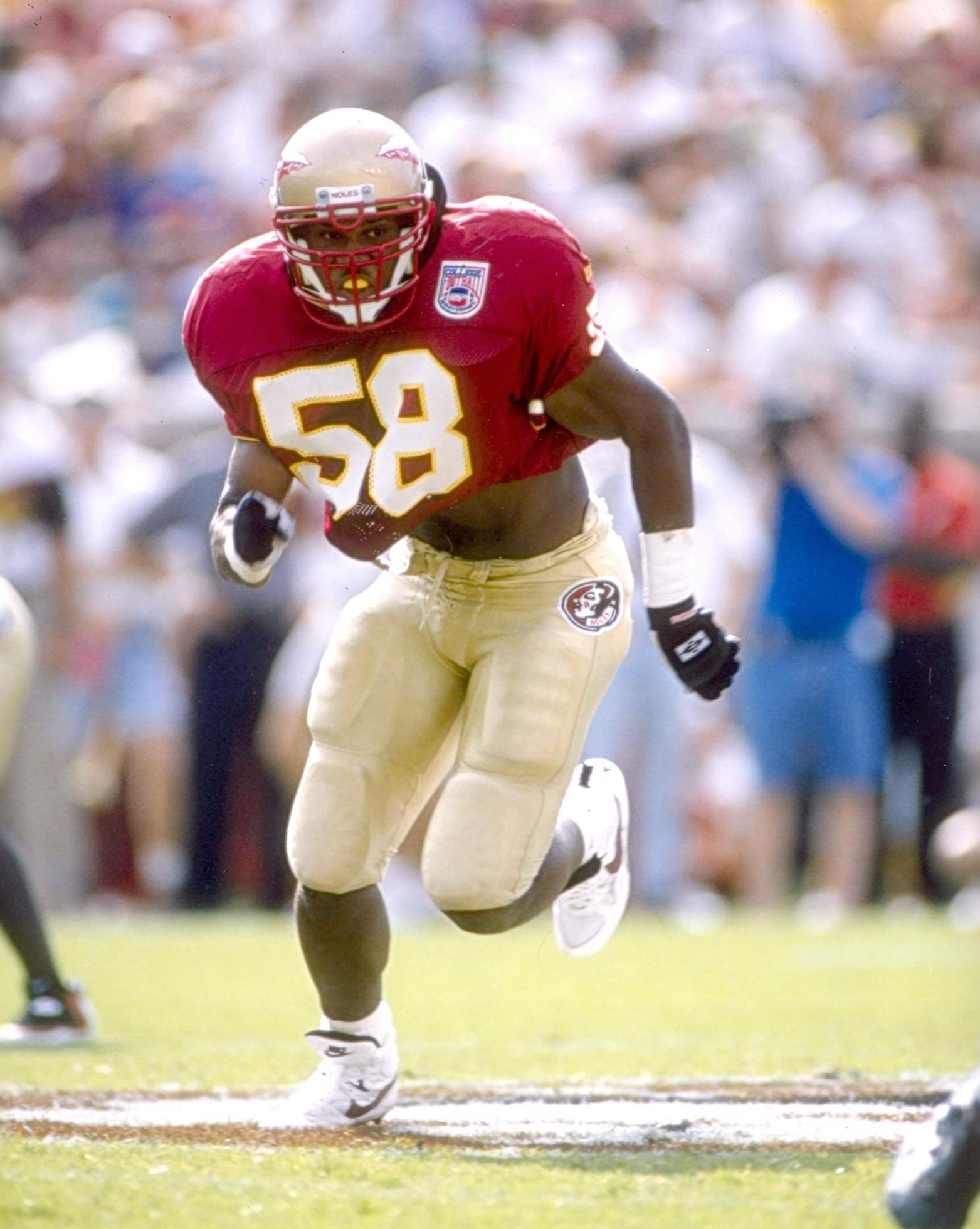
One of the first times I saw this technique was in November of 1996 when FSU beat Florida in Tallahassee, on what would lead to the best revenge game I've ever seen in the national championship game that year.  Florida lost that regular season contest 24-21 and Florida quarterback Danny Weurffel took the worst beating I've ever seen a quarterback take in that game.  Weurffel was sacked 6 times and hurried numerous other times that game by the likes of Peter Bouleware, Reinard Wilson, Andre Wadsworth and countless other Seminole defenders.  I never gave it another thought until in 2005, the team I was coaching was facing an opponent that had it's defensive ends in an odd look.  They were tilted, looking almost in, down the offensive line at a severe angle.  I remember back in the day, the Jimmy Johnson 4-3 guys called this "Smoke", but I'd never seen such a radical tilt by a defensive end.  The other thing I noticed, when watching our opponent on film, was the absolute reckless abandonment the ends had.  They flew in like mad hornets, struck whatever was in their path, ran down plays from behind, and in general, made life miserable for opponents.  The defensive coordinator (DC) I was working for at the time, when asked about this, called it the "jet technique".  He had heard the opposing head coach speak at a clinic a few years earlier on the technique and how it worked.  The more and more I watched it, the more I was absolutely mesmerized by it.  Now, don't get me wrong, our opponent had some cats, they could flat get with it, and their entire defense played with this reckless abandonment.  Anyhow, in the span of 10 seasons, I faced this team at least once every year, only beating them one time.  In seven out of 10 seasons, they utilized the jet technique with great success.  Having had the chance to work with several members of that staff here in the recently, I'm going to elaborate more on how it is taught, it's similarities to regular, block down, step down (BDSD), how not to play the technique and the pros and con's of the technique.  I will also add in how this technique ties into the linebacker play behind it.  A lot of this will not be new, but what will be new is the manner in which the scheme is delivered, by turning loose some of your most aggressive players on some of the offense's weakest players.


The technique
The technique is no different than that of a standard BDSD defensive end.  I had to learn this pretty quickly, as on film, it does not look quite the same.  The reads are basically the same versus the four standard blocks a defensive end will see.

  1. Base block- the DE will attack the near hip and press the blocker back down inside to constrict the running lane and play the spill by the outside linebacker (OLB).
  2. Reach block- the DE will attack the near hip of the blocker and work vertical, to set the edge and force the ball carrier to either cut back, or to "bubble" into the backfield.
  3. Down block- the DE will come flat down the line attacking the first threat to him as he reads down the line to up the field.  This threat could be a pulling guard, kicking out lead blocker, a dive back, or the ball being run away from the DE.  In the case of the ball being run away, the DE is to chase, chase, chase with reckless abandonment in an attempt to get to the football.
  4. Pass block- the DE will attack the near hip, and work vertical to contain the quarterback in the pocket.
Jet vs. base block

Jet vs. reach block

Jet vs. down block


The key component, as with any technique, of jetting, is the footwork of the DE.  The DE must not step up field.   I cannot stress this enough, as if the DE is up the field, he has made the offense's job that much easier blocking him.  The DE must step AT his target.  Even though hand placement, as with standard BDSD, is not critical, the steps, still are.  The DE must step at his target, THEN make his read and adjust his path to the attack point accordingly.  A key item in teaching the DE's feet, is the placement of the down hand when in his stance.  If at all possible, get your DE's to play with their inside hand down.  This will almost naturally force the DE to step into his target.  As with anything that involves technique, the footwork is ever-so critical when teaching jetting.

As you can see, this is all pretty standard stuff.  No real shockers in technique here.  What is the shocker, is what a simple change in alignment, stance and mentality can allow for when it comes to the selection of personnel.

Alignment, Stance and Purpose
The DE assumes a sprinters stance, looking down the line of scrimmage (LOS).  In some cases, the DE is actually parallel with the LOS.  The DE will align one yard outside the EMOL and take this tilted stance.  What this alignment and stance do, is allow the DE to come off like a rocket (we often used to call them "wick lighters" or "bottle rockets"), attacking the blocker at a very high rate of speed.  This makes the defender very difficult to block due to the high rate of speed they can attain.  The more athletic the DE, the wider he can align, thereby making it more difficult for him to be blocked.  The width of alignment also gives the DE the element of time to diagnose the read he is getting.  It also clarifies this read, because of the width of the DE, the blocker has to make a tremendous effort to get to him on the base and reach blocks.  

Jet Stance

The purpose behind all this, is to allow the DE's to play fast and be reckless.  Many coaches having called jet DE's "wrecking balls" or "crash test dummies".  The other purpose behind the technique is that it allows a smaller, quicker athlete to play the defensive end position.  Not everyone is blessed with 6'2" 220 pound DE's in high school.  I have seen DE's as small as 160 pounds play this position with great effectiveness.  The key element with this technique, is the selection of the player to play this position.

Player Selection
The jet DE needs to be some of the names I've mentioned above, such as "wick lighter", "wrecking ball" or "crash test dummy".  They need to be relentless, have zero fear of contact, and understand their role within the defense.  They must be a player that knows, they may not get very many tackles, but that they will get to make contact on just about every play in the game.  The DE must relish contact.  He must not shy away from it, and as many have said, he must be the "bull in the China shop".  Our opponent for the past ten years, has utilized extra wide receivers, tight ends, and even running backs that weren't labeled as "offensive players" to fill this role.  They all shared the above traits in that there was a universal love of contact.  A lesser athlete can pay this technique, but it does need to be modified a bit by tilting the DE more parallel to the LOS and playing him a bit closer to his read, so that he can close the edge a bit better on down block reads.  

Pro's and Con's of the Jet Technique
The pro's of the technique are as follows:
  • It allows for smaller, quicker players to play defensive end in a four man line.  How many times have you heard a coach switch to the 3-3 or the 3-4 because "we just don't have that many defensive linemen (DL).  Jetting, allows the smaller quicker player be effective, so long as they like contact and are not selfish.
  • The smaller, quicker player, coupled with the wide alignment makes the DE very tough to block.  You can almost count on not reach blocking this player with an offensive tackle, and even tight ends (TE's) have trouble with them.  Their head of steam coming off the ball, coupled with their quickness usually stones lead blockers coming from depth, even if said lead blocker outweighs the DE.  You can try optioning off of them, but the quarterback is usually going to pay because of the ferocity at which these DE's come off the football.
  • The reads are very simple, and are a visual key, rather than a feeling key (the way BDSD is).  For years, I've had trouble with the DL getting their hands on a blocker to be able to "feel" the blocking scheme.  The jet technique plays right into what kids use most, their eyes.  The DE doesn't have to feel what the blocker is doing, he gets to see it, then attack it.  By playing into what most high school players already utilize the most, their vision, it allows them to play fast and aggressive, as they trust their reads.
  • It is easy to teach.  You can literally teach the technique and reads in one practice session.  The key is continually repping the fits of the various blocks.  The other key is breaking any selfishness by a DE wanting to "make a play" and not stay within the scheme.  
The con's of the jet technique are:

  • It exposes linebackers (LB's) to down blocks.  This point is argumentative, but I bring it up, because it is the largest flaw I have with the technique.  Since the DE does not get hands on the blocker, the blocker gets a free release to a linebacker.  Now, if it's the OLB, this block is very tough, however if it is the middle linebacker (MLB), then this block is executed quite easily.  The argument here by the proponents are that because the DE "wrecks" shop in the backfield and spills the ball laterally, it allows time for the MLB to get off this down block and pursue the football.  I'm sure this could be debated for hours, but this is my number one gripe with the technique.
  • Lesser athletes struggle playing the position.  In my opinion, you need some pretty athletic DE's to play this spot.  They need to be able to see the read and redirect on the run.  Some kids I've coached, quite simply do not have the natural ability to do this.  If they do not, you can adjust the stance and the alignment some, but not to the point that it is as effective as if the player was a very good athlete.
  • It requires an absolute desire for contact.  In this day and age of the "softening football player", it may be hard to institute this technique because the player must be willing to sacrifice statistics for the love of contact.  Many players we get, simply don't like this, and are very hard to break of their selfishness.  The other thing, is that if they are soft on contact the DE will not be in a great position to constrict running lanes on base blocks, or spill the ball on down blocking gap schemes.  
Jet Technique Coupled with Linebacker Reads

Again, none of this should be Earth shattering, but all of it, is very fundamental in teaching the reads and run fits of the four man front when utilizing the jet technique.  Looking at the reads, from the four reads given above, the LB would react as follows:

  1. Base block- the way I have taught the technique, to keep it simple is if the DE is outside with his read, the LB is inside with his.  If the DE is inside, the LB is outside.  So versus the base block, the DE is attacking the hip and constricting the inside run lane and is outside, so the LB must fit inside this block into the open gap the offense is presenting.  
  2. Reach block- the reach is taught similar to the base, but once the ball has declared itself out of the LB's open gap, he is free to scrape and chase the football outside where the secondary run support should be turning the ball back into both the DE and the OLB.
  3. Down block- on the down block, the DE is inside, so the LB must gap exchange and now be outside.  The LB will scrape and replace the DE, as the DE spills the block, or tackles the dive back.  Again, nothing new from BDSD, other than how the DE attacks the blocker.
  4. Pass block- obviously here, the OLB would read that the OL is pass blocking, and will now get into whatever pass drop the coverage the defense is in would require.
LB reaction vs. base block on DE

LB reaction vs. reach block on the DE

LB reaction vs. down block (note how exposed the MLB is on this play)
Conclusion
In conclusion, I think the technique has merit.  However, I think you have to have the right folks to run it.  You have to have some absolute wrecking balls at the DE position, that love contact and are not selfish players.  As with any technique it must be taught properly as well.  Improper technique will lead to the DE being out of position which, in turn, leads to huge holes created in the defense.  If properly taught, with the right individuals playing the technique, one can have some very good success using Mickey Andrew's jet technique.


Duece