Showing posts with label University of Florida. Show all posts

Steve Spurrier and His Influence...on ME...

With all the stuff out about Steve Spurrier here recently, and how folks are finally seeing just what a good coach he his, despite his witty wisecracks, and penchant for running up the score, I thought I'd share just what an influence the Head Ball Coach has been on my coaching style.  I'm in the middle of season, so this won't be a post with a bunch of "bells and whistles" like many of my others.  Nope, this will just be a "quickie" so to speak (lol).

Spurrier, was the first head coach I idolized.  So much so, I still wear a visor on game day to this very day.  So much so, I once named a favorite trick play "Spurrier", because much like who he was named after, it was a thorn in our opponent's sides.  I grew up, and am still to this day a die-hard University of By-God Florida Gator fan, and when I was coming into my own with football, Steve Spurrier was just getting going at UF.  I watched many a Saturday where the ol' HBC (by the way, for you guys that say it's "Ol' Ball Coach, it's not.  It is, has and always will be the HEAD BALL COACH!!!) would turn a football game into a 7 on 7 version of a track meet.  I was always in awe of just how open his receivers would be.  I was also in awe at how he took meager quarterbacks and made them look like world beaters, and in some cases even Heisman Trophy contenders.  No doubt, the HBC was my guy, and if I ever became a coach I wanted to be just like him.

Link: Good article from Coach Hoover on Spurrier's offense with link to playbook.

Early Coaching Influences
Spurrier's knack for rubbing people the wrong way was probably the first talent I developed as a coach, however, I was long before classified as an "asshole" before I even started coaching.  Hey, it is what it is.  I get my point across and you know where you stand with me.  The HBC is no different.  He tells it like it is, even if that means rubbing somebody the wrong way.  At least you know where you stand with him.  I always loved the "You can't spell Citrus without UT" comment.  That is one of my all-time favorite "Spurrier-sim".  Anyhow, my first coaching gig was a youth league deal where I lived.  Folks there knew I had played/coached in college and were in need of coaches, so I took the deal.  It worked out with my work schedule, and though I had just finished up coaching 17-22 year-olds, I thought "What the heck?", how hard can it be right?!  Well, I was in for a big learning session that year, but my lack of words to folks who weren't getting the job done wasn't every a problem.  I mean, I feel, if you're given a task, whether it be volunteering or whatever, do it the best you can do it, and don't screw it up.  If you do, I'm going to tell you about it, because I want you to feel uncomfortable about what you just did, so you don't do it the next time.  That flew about like a lead brick in my new HC gig, but like I said, folks knew where they stood with me and they knew what I wanted and expected out of them.  Much the same is with Spurrier.  He tells it like it is, and if that doesn't sit well, you can pack it up and move on, or buckle down and do your job (just ask Ron Zook).  That's what I really like about the man, is that it's either black or white, there is no gray.  You either do your job right, or you don't.  When you do your job, you get praised, when you don't, you're told about it in a manner that makes you feel pretty uncomfortable.  I'm cool with that, and once most people get over the initial shock of "Did he really just say that?", they are cool with it too.


Another item I took from Spurrier's playbook, was not only making some folks uncomfortable, but making opposing defenses uncomfortable, and doing so in what was considered an unconventional method.  When I got into this youth league I watched some film of the previous year, and the craziest thing out there was some single-wing!  Most teams were I, or split backs running isolation, power, sweep etc.  Well, not this guy!  I came in and we installed our version of the "Fun-n-Gun" offense.  We ran out of the "I", but the lead draw was our base play.  Just like the HBC, that was our playaction on every pass play.  Now don't get me wrong, we ran some dive, trap, toss sweep and a nifty counter toss-sweep (also from Spurrier), but the lead draw was our staple.  The more and more we played the more I recognized that nobody was spreading the field much.  Well, in my second year there, we started to open it up a bit more.  We played a lot of 11 personnel and went into the shotgun.  I remember folks saying "You can't throw the ball that much here and win.", or "That won't work here.".  Well it did, to the tune of a 1-9 team going to 5-3 the next two seasons.

I used to have opposing coaches come up and say "How do you get that kid to shotgun snap at such a young age?".  To which I'd just chuckle and say "You gotta rep it coach.".  So many of these guys were stuck in their ways that thinking outside the box just didn't happen.  I'm glad I had a guy like Spurrier, who's whole career as a football coach has been defined as thinking outside of convention.  Another thing we did was to run the read option early on, which nobody was doing, and barely anyone was doing even in college football.  I had installed a zone blocking scheme for our OL when I came in, and one day when we ran our lead play out of the gun, my QB said "that end is crashing real hard coach, why don't you ever let me keep it?".  I asked him, if he thought he could read that end, and make a decision and he quickly replied with a "Yes!".  So we ran the zone read before zone read was en-vogue!  I also ran jet sweep before Wes-Elrod made his living writing books and opening up www.jetsweep.com (mostly because I actually coached against Wes in college and had seen it, and liked what I saw and what the jet sweep did to defenses).  Again, all this leads me back to my Spurrier roots, because it was things that nobody else around was doing, and it was things that made opposing defensive coordinators, very, very uncomfortable.


You see, what I relished about Spurrier, and what went along with the situation I was in, was that he and I seem to be at our best when somebody says "you can't do that", or "that won't work here".  I've been getting it all my life, and so has Spurrier.  See, he was a skinny QB, that not many folks really cared about recruiting, yet turned out to be a Heisman trophy winner.  I was the same way, a short squatty offensive lineman, who nobody thought would amount to much, that ended up playing small college football and getting a large portion of my degree payed for.  An offensive lineman who at 5'9" tall, and a whopping 245 pounds started next to a 6'2" 265 pound center, and a 6'5" 315 pound offensive tackle.  The guy's job that I took, was 6'4" and 260 pounds.  That's the stuff I like.  Back me into a corner and tell me I can't.  Tell me it won't work.  I get a lot of that from my dad, but it was honed and sharpened by watching the HBC throw the pigskin around on Saturday afternoons in Gainesville.  Don't tell Spurrier something won't work, he'll make damn sure it does, and then he'll tell you about it!


So when I entered this youth league and wanted to throw the ball all over the place with three and four receiver sets, and run zone read option, folks thought I was an idiot and made their same old statement, "Can't do that here".  The guy that hand signaled in every play to his QB on wristbands, and could go no huddle if he wanted to at any time, was also told "That won't work here coach".  Yep, none of that would've worked had I done what many coaches do, and simply listen to the critics.  What I learned from Spurrier is, they don't matter.  You know what does matter, the guy you look at in the mirror everyday.  That guy matters, and he matters the most.


One thing from my early years I must reflect upon because it's actually quite comical is the trick play I referenced above, aptly named after my favorite football coach, "Spurrier".  What it boiled down do is shown below.  Yep, just the old halfback pass, however I added the element of option to it.  The halfback, if everyone dropped off in coverage, could simply turn it into sweep.  However if the corner bit on the sweep, he would toss it to the wide open Z receiver.  If the defense over pursued to the sweep, he could then turn and toss it back to the QB who had run what many would call a bubble route, however we just made sure he was deeper than the RB.  The QB now had the option, had everyone left him alone to turn the ball up and run it.  Now, if the corner had stayed home for the reverse, he had another option, and that was to hit the X receiver on the Sally route, for  a touchdown.  Seems like a lot for youth league right?  Nah, just gotta rep it!  We would run this on air 10 time and live 10 times everyday.  As the season progressed, we could do it less and less to where these kids could do it in their sleep.  I once ran this in a game, six times.  Let that sink in...six times!  I remember their coach yelling "They're running that play again, that trick play, don't get beat deep".  Every time it worked for a first down, or a touchdown.  The opposing coach was so embarrassed, he wouldn't shake my hand after the game.  Hey, sometimes you gotta do what you gotta do!


Later Influences
As time has gone on, and Spurrier's career left the University of Florida, I've kept my eye on him.  I was a bit shocked he didn't turn the NFL on its ear, but the NFL has been a killing ground of innovative coaches.  Say what you want, but even the Chip Kelly's of the world aren't doing EXACTLY what they did when they were in the collegiate game.  They have to modify it some.  Spurrier wasn't going to do that, he was going to do it his way, even if that meant sinking with the ship.  His time in the NFL was rocky, and many folks criticized him, but in reality it was good for him.  See, Spurrier, at UF, was borderline larger than life.  Hell, who am I kidding, in the State of Florida, he's a god.  I think every man needs humbling now and then, and Steve was no different.  I went through the exact same thing, from getting a high school head coaching job, and then getting let go, all of which helped humble me as a coach, because quite frankly before getting the job I was touted as a very good football coach.  So was Spurrier, and many thought the NFL was in for a ride when he came on scene.  However, even one who may be labeled as the best college football coach ever, Nick Saban, couldn't win in the NFL.  It's quite simply, a different game.  I learned this lesson as well, and with tail tucked between my legs, left the high school game, and went back to coaching junior high ball for a humbling two year stint.

Spurrier sat out of coaching for a while too, and once the South Carolina job opened up, he jumped at the chance.  A challenge.  Win, where winning wasn't traditional.  Not to say that Lou Holtz hadn't helped Spurrier a bit, but let's be honest, Holtz's influence has long since vanished from South Carolina.  When Spurrier stepped back in the ring, you could easily tell he wasn't the same snippy coach.  No, he seemed on a mission, and that's exactly what he's been on.  The more and more he's been successful, the wittier he's gotten, until now, he's back to the old Spurrier.  I have faced just such a thing myself, and watching him go through it has shown that being humbled is not a bad thing.  In fact, it is quite the opposite.  Being humbled really has helped me as a coach.  I've learned not everyone needs to be told exactly what you're thinking all the time.  Choose your words and pick your battles.  What I've also learned is to be adaptive.  Adapt to what you have, make it fit your players, work through kinks etc.  Spurrier has done this too.  His offenses at South Carolina, though they still have some of the old flair to them of the "Fun-n'-Gun", they aren't the same offense.  Spurrier has learned to adapt, use the running QB, go no huddle, and yes, by gosh, run the ball when you have to.  Yep, I'd say he's come a long way from the pass-happy Fun-n-Gun.  Many say he's an innovator, and no doubt he's changed the game, but he's also proved, that he'll do whatever it takes to win.

One of the biggest contributions I got from the HBC, was that he not only does it his way, he does it the right way.  You rarely hear of any of his teams getting busted for violations.  Now, I know, he's like every other coach, and has players that end up having brushes with the law, but to be honest, everywhere Spurrier has been he's run a clean program.  Bobby Bowden, Urban Meyer, Jimmy Johnson and the lot cannot attest to having the same track record.  Sure, they've won more championships, but at what cost?  Spurrier is the benchmark of what a clean program should look like.
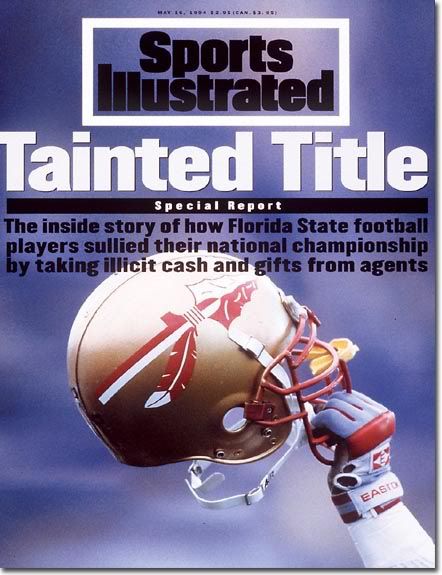
You won't see this heading anywhere near a Spurrier run program!
 
What I've really picked up from Spurrier though is the fact that football doesn't need to consume your life.  For me, when football season rolled around, everyone knew, I was going to disappear.  When I was the head coach, it was football 24-7.  So much so, that when I got canned, I looked around and realized "Where the hell did the last six years of my life go?".  Sure, we had won games, been successful and then slowly slid downhill after that to the point of me getting let go, but what had I missed?  In the process I had missed my great grandmother's 98th birthday, two cousins weddings, several family members being born, and being an avid hunter, just about every deer season the past 14 years has been pretty uneventful!  I remember when it was all over, just feeling so damn lost because football wasn't in my life.  I think we all would feel that, and even the HBC would admit to being that way too, however, he could've been just as content playing golf somewhere.  Spurrier took time off from the game and it rejuvenated him, as it did me.  I went and helped a friend coach a struggling junior high team, and to be honest that may have been the best two years of my coaching career.  Not in terms of wins or losses, but in terms of what I learned.  It's a game, have fun with it.  Have fun with the kids, that's what they are out there for, why not have fun with them?  I did just this for two seasons, and then the call came for me to come back to the high school ranks as a defensive coordinator.  Two years off, and I was rejuvenated and ready to work.  Ready to get back to the grind.  Well, three games into last season, giving up over 400 yards of total offense per game and sitting at 0-3, I realized I had become the same man I was before my firing.  Three hours of sleep, no patience, being snippy and actually dreading going to practice had become the norm again.  Thank God I have a head coach that had the intestinal fortitude to see this, and say "stop it".  Let's go super simple, learn our assignments and get the kids playing faster.  Well, we did just that.  I went to bed at ten every night.  Scheme was super simple, no more crazy hours worked.  As the year went on, I began to have more and more fun with it. We turned things around, and although we weren't good on defense, we made the playoffs for the first time since 07'.


I was going to resign at the end of the season, but something has kept me going.  I told myself this season, I'm going to do what I did for two years with the junior high program...have fun.  So far I am.  It has been a bit stressful, and I do still grind some, but not like I used to.  I get up and go hunting every Friday morning before the game.  I go out on dates with my wife during game week, and most importantly I don't yell anymore to get my point across, I coach, correct, smile and have fun.  What does this have do with Spurrier?  Well, it's really how he's always done things.  He's never been a grinder, and look at the success he's had.  I figure if he can do it, anyone can, and I'm going to give it a try!  So far, I'm loving it.


Football is a wonderful game, but it's the people involved with it, that make it really special.  I have missed that.  I look back on some of the good teams I coached, and even though I had a relationship with my players, it was more like a business relationship than a coach-player relationship.  I have definitely changed in my approach to how I relate to my players.  I make sure to ask them, how they are doing, what is going on in school and at home.  Where I used to walk out of the locker room and go home at the end of the day without speaking to one player, I try to stop and talk to all of them.  Lastly, something I didn't get from Steven Spurrier, but from another mentor of mine, is always stop and look a player in the eye and shake his hand when asking him how his day went.  That little piece of advice has really helped me bridge the gap from lab rat defensive coordinator to "coach".  Sure I'm still blunt in the way I correct guys, but at the end of the day they know I have their back, and they know our relationship is more than just business.  You know, in many ways, Spurrier is the same way.  This is the guy that has suggested coaches assist in paying players so that they would have a "piece of the pie" of the money that college football rakes in every year.  He cares about the players, even though he may not always show it, or have a funny way of showing it.  Whether you like him or not, there's an awful lot there to respect.  I think even ol' Bobby Bowden would agree to that (dadgummit)!!!


Anyhow, just something I thought I'd share with you.  I didn't really know how big an impact Spurrier had on me, until I began reading the articles about him.  I think he's a remarkable coach, and I hope he still has a lot of years left in his tank.  I think Steve Spurrier is good for college football.  I think college football would agree...

Duece

Defending 3x1 Formations Part V


Part V of the series on defending 3x1 sets is dedicated to pressuring your opponent when they choose to line up in some form of trips formation.  As many coaches have asked me over the years "How do you keep your blitzes sound when they go 3x1?".  It's not rocket science, but you do have to be willing to get a bit out of your comfort zone sometimes.  In this post, I'm going to go over some of my favorite pressures over the years and the how's and whys of running them.  Before that, though, I think the idea of why you pressure and when you pressure is essential.

Blitzing With a Purpose
Most coaches think that blitzing is gambling, or "sending the house", while some coaches think blitzing is what defenses do.  The real idea here (and it's one I've harped on in all four of the previous articles) is attacking your opponent based on scouting data.  Obviously, the less you know, the less you want to pressure until you feel you have a grasp for how it is that your opponent plans on attacking you.  With scouting data though, and tendencies, you can now dial up stunts and blitzes that are geared towards making your opponent play "left handed" so to speak.


Last season, we faced an opponent that would get into trips open, with the running back (RB) set to the trips.  When they did this, they would do 1 of 3 things.  First they'd run speed option into the trips.  Secondly, they would sprint out into trips and run a flood pattern concept (shown below).  Lastly, they would fake the inside zone run, and throw a bubble screen to the number three receiver (again, shown below).


That was pretty much all they did out of this look.  They would even flop the RB over and run one of these three plays.  That my friends, is what you call a tendency.  This was something I felt I could exploit, and we did.  We ran a version of TCU's dog blitz, or the good ol' NCAA blitz, but we made sure to have the flexibility built in to the defense to be able to blitz to the RB.  This allowed us to overwhelm them on the option and sprint out, as well as playing man to man coverage vs. the bubble screen look.


Folks, this is nothing new or revolutionary, it's simply using a tried and true blitz, mixed with good scouting data (I had 6 games on them, 5 of which were vs. 4 man fronts).  This took them out of what they liked to do out of 3x1 gun strong.  They tried to run zone read out of this look, but the stunting tackles makes life miserable for the OL, who now no longer have angles and end up pushing the DL into the path of the RB forcing the cutback to the unblocked blitzing LB.  This was not pressuring for the sake of pressuring, but a well calculated risk that ended up paying off in the long run.

Film study folks...that's all it comes down to.


Solid
Solid was introduced to me a while back, and if you are a base nickel defense, Solid is an awesome adjustment to 3x1 sets.  Solid by itself, is just what many refer to as Palms coverage.  The trips side isolates #1 and #2 and plays them in either a Two read, or Quarters concept, while the weak side of the coverage plays some sort of standard high-low, three-on-two bracket on the back and the single receiver.


I can already here the moans and groans.  "Duece, what about handling #3 vertical?".  I get it, hang in there.  Yes, Palms coverage main weakness when played to trips is the ILB having to handle #3 vertical.  Now, if through scouting data, the team you face doesn't do this, your golden.  Simply play your Quarters variant to trips, and then get a good double on the single receiver with any of the concepts listed above.  Sky is obviously a low-high where the safety robs the curl to flat and will help play inside and under the number one receiver.  Cloud is simply this low-high variant reversed.  In either one, you have a deep half player (sky = corner, cloud = safety) along with a hook player (the LB) to give you a three-on-two advantage that a coverage like Solo does not.  MEG is two man.  This is still similar to Solo, but the main difference is the weak safety (WS) does not have to concern himself with covering #3 vertical to the strong side of the coverage.  MEG, allows you to double any deep route by the single receiver, the back or both with a half-field safety.  MEG is an easy installment if you already run Solo.

The real idea behind Solid is the the last three ways of playing the weak side of the coverage.  Smoke, Cowboy and Backer are all pressures built into the coverage.  They are still man concepts, but instead of being three-on-two, you are now bringing pressure from one of the three players, and essentially playing Cover Zero on the weak side.  Smoke, is the weak safety coming off the edge with the LB handling the back and the corner playing man on the single receiver.


Backer is the LB blitzing the open gap to his side.  It could be the A gap, or the B gap.  You can really set it up however you want, I just chose to always blitz the open gap for simplicity's sake.  Now the safety will roll down and play the RB man to man, while the corner remains manned up on the single receiver.


Solid Cowboy is a corner blitz, and is an excellent pressure when brought from the boundary.  The DE fires inside and the corner comes off the edge.  The WS will now man the X receiver while the LB takes the back.


As you can see, this is quite an easy pressure package to adapt to your trips coverage.  The blitz can be game planned, or simply built in as an auto-check if need be.  The possibilities are endless!

Now, for those that aren't comfortable with playing the vertical of the number three receiver with a LB, there is an answer for this as well, and this is why I stated earlier that if you base out of nickel personnel then you're in good shape.  The coverage call is Special Solid.  Special, or what some others call "Mix", is a man concept on the strong side, or trips side of the defense where the corner will play the number one receiver man to man while the invert and deep safety play a Two Read concept to the number two and number three receivers.  When it's all put together you've got quite a nifty little pressure package that's built in to what most nickel defenses already do.


Now you have a way of controlling the number three receiver vertical, as well as still being able to do whatever variant you want on the weak side.  This flexibility is what is needed in today's defenses, when having to contend with no-huddle, up-tempo offenses.  This coverage/pressure adaptation is easily adaptable to many existing coverage schemes out there.

Attacking the Run
In my opinion, every blitz you run should be sound vs. the run, especially the option.  There are numerous blitzes I could go into, but I think you need to look at a few things first (again, blitzing with a purpose) before just wildly firing off at the hip with a myriad of blitzes.  The types of runs you face, are going to, by-and-large effect the blitzes you need to call.

Defending zone schemes with is usually done a few of ways for me.   I have heard this concept called "Flick", "Hawk", and "Press".  Anyhow, looking at the nuts and bolts of the pressure is simple, because it's not really a blitz, but more a leverage issue created by alignment.  It is a read pressure, meaning that if the LB reads pass, he will still get his drop, but if run is read, he will immediately fill the gap he's aligned in.


Pre-snap, the WILB, in the above diagram, simple walks to a toe-heel alignment with the DL and sits in the B bap.  He's reading the OG to his side, and if the OG fires off, he will blitz the open B gap.  As you can see, the OG has no leverage and is in a poor situation.  If the OG comes off, this leaves the center attempting to reach a 2I, and unless, he's one of the Pouncey twins, the likelihood of that happening is slim to none.  On the side of the RB, the offense already has leverage issues because the OG has to try to come under the three technique to get the other ILB.  The ILB plays the cutback to the A, or, if playing TGOG, can play over into the B gap while the three technique two-gaps and ends up in the A gap.  The DE plays a 2-for-one read by squeezing down, keeping the shoulders square and playing for the pull by the QB.  The offense is in a no-win situation, as if the QB gives the ball with the DE's read, or if the OC simply calls the zone to the soft B gap bubble, they are in trouble.  Again, this is an easy install and read for the LB.  If the OG were to high-hat, he would drop out and play his pass assignment.

Another way of defending these zone schemes is with pure inside pressure.  TCU's bullets scheme is a good way to handle zone teams.  I like setting the DT's evenly either in 2I's, or threes and then blitzing or stunting and blitzing to confuse the offense.


The idea here is sheer numbers.  The offense cannot account for 6 players blitzing without somehow adding a lead blocker.  It should be noted that an even more effective way to run these blitzes vs. zone teams is to have the LB's align toe-to-heel with the DL.  This keeps the OL from being able to execute their signature double-and-scrape technique.

Lastly, I like to run what TCU terms their "Smoke" blitz against zone teams.  What I prefer to do is set the front to the back, then slant away from the back and bring pressure off the edge.  What this does is invite the offense to run zone to the soft B gap away from the back (some teams actually check to this).  It also dupes the QB into a pull read that has him running right into the teeth of the blitz as well.

Smoke to back away from trips

Smoke to back set to trips
A schematic point on the Smoke blitz is that when blitzing the back set to trips, it may be a little more convenient to have the SS make a "switch" call to the ILB and send the ILB instead.  Again, this is based on preference and what you are attempting to achieve, but usually the strong side is to the field, and having the SS come from so far, all the while having the WS have to come over and cover #3 strong can be a lot of moving parts for some to handle.  The easy adjustment here is to simply switch the call between the SS and the ILB.

Defending gap schemes can be a bit tougher, due to the fact that determining when and where they will hit can be a bit challenging.  One scheme that comes to mind is Power and Power Read.  The new craze with offenses in the option game is the Power Read scheme.  We faced a team a couple of seasons ago that ran this play, but also ran QB Power and QB Isolation back to the RB.  The Smoke blitz from above is another good blitz vs. gap schemes.  What we ended up doing is setting the front away from the back, and then also slanting away from the back.  We also set the front up with a 1 and a 3 instead of the traditional "G" look.  The reasoning here is that when the offense pulls a lineman, they now gain a full man advantage on you to the side the OL is pulling.  If your numbers were matched pre-snap, you are now one full man down on the side the offense is attacking.  The Smoke blitz allowed us to bring pressure to the side the offense ran Iso and Power to, but by slanting to the Power Read side, we made life miserable for them.  When we called this, the strong end would align wider than normal (about like a 9 technique).  This allowed him to still work on plays away from him, but also put him in great position to attack the sweep portion of the Power Read play.


Two key things I liked about this pressure was this:

  1. The ILB's did not blitz.  This allowed them to make their reads, and "clean up" anything the blitz didn't get.
  2. It's only a five man pressure.  Against 3x1 formations, you can run a zone concept to the trips side and a man concept away similar to a zone blitz, or Cover One scenario, not leaving your defense as exposed as if running pure Cover Zero.
Another thing I liked about it, was the three technique slamming into the OT, helped pull the guard over, creating a huge gap for our Nose to run through.  The center, assuming he's blocking back on Power Read, missed this block quite a few times that night.  Our Nose had a field day with this call.  You can even run this look against traditional two back power teams.  The idea is that by crossing the Nose from weak to strong, you match the numbers that the offense presents to the attack side by them pulling a lineman.  

Attacking protections
I know most coaches want to hear how to attack specific protections.  For the most part this works, and yes I've got blitzes in my toolbox that work for Slide, Turn back, and Big-on-Big (BOB) protections.  However, I think the protection is only half of the big picture when pressuring the pass.  I think through diligent film study, you need to find the two weakest members involved in pass protection, and find ways to attack them.  Sometimes this can be a undisciplined OL that tends to chase a stunt, rather than pass it off.  This may be a RB in slide protection.  Whatever it is, identify the two weakest elements of the protection and work from there.

When attacking protections, there's a few ways to do it.  I narrow these down to attacking the flaws in the protection, vs. deception.  Most on here, know how or have at least heard how to attack various protections.  The good ol' NCAA blitz to the RB's side in Slide protection is one that comes to mind here.

America's blitz!

Obviously the idea here is to overload the protection by sending four to a side that only has three blockers.  Teams are wising up though, and utilizing Half Slide schemes and vertical set pass protection etc.  I feel more and more, disguise and deception pressures are of more order than simply breaking down the intricacies of the individual pressures.  

One very deceptive pressure, isn't really a true "pressure" in the sense that most think.  Only four will be rushing, but it's a read rush.  What happens is out of  a six man box, the LB's walk up to the outside of the DE's and are on the LOS.  The DE/LB combo reads the block of the OT.  If the OT blocks down, the LB blitzes and the DE drops.  If the OT kicks out, the LB drops and the DE rushes inside the tackle.  This provides a bit of confusion as to who is blocking who on the OL.


This can be a real good empty pressure too, because a lot of times it gets empty teams to check to some sort of hot route, and with two immediate droppers working into where offenses like to throw hot, you can get a free sack by simply confusing the QB.

Another blitz that has been a good one to me, that also has a deception package built into it is Florida's Nickel Tracer.  I wrote about it a while back, with some help from my good buddy Coach Hoover.  This blitz is a good one, in that you really end up running the "Trick" version of it more than the actual blitz.  

Again, not all pressure has to be sending five, six, or seven rushers.  The mere appearance of pressure is sometimes good enough to confuse offenses into checking into a bad call or bad protection.  I know many of us as DC's want to throw a myriad of blitzes at our OC counterparts, but something that has worked for me for years is a call I simply tag "Bluff".  Most of my blitzes are one word calls, so we simply tag the blitz Bluff.  For instance our Will off the edge blitz is WOE.  If we are planning on running that blitz a bunch, then we will also work on WOE Bluff.  Here the WLB walks up as if to come off the edge but backs out at the last minute and plays base defense.  Pretty easy concept to install, and can easily create as much confusion as if you actually blitzed!

"Check, check, 55 Deuce Tampa, 55 Deuce Tampa!!!"


Conclusion
Pressure packages are what send all DC's into a frenzy.  I'm sure if someone studied it, books on defensive pressure are probably the top sellers.  In my opinion, there's no exception for dedicated film study.  A defense that is prepared, and well-versed in what and how their opponent plans to attack them can look like they are blitzing and attacking even when they are playing base defense.  Don't get caught up in all the zone blitz schemes and blitzes-of-the-week talk that has folks so fired up on the Internet these days.  Work the hell out of your base package, do tons and tons of film study and teaching to your players.  All this being said, it is good to have a few things up your sleeve that may help your kids in certain situations.  Again, when and where to use these, are a product of dedicated film study and game planning.

That concludes the posts on Defending 3x1 sets.  I hope you enjoyed them, now I can get to writing about some other topics!  Take care.


Duece

On Vacation...


Been on vacation, still struggling to get back in the groove of things, so bear with me on future blog posts.  Hopefully I can get my typing fingers back!  So in order to wet your whistle I'm going to give you some good links to check out.

Over at Smart Football there is a very good article on Combining the Shovel Option With a Sprintout Pass.  Good read on an age old concept made recently famous by our in-house favorites the Florida Gators!


Gridnotes is a great collection of articles, so much so you probably couldn't read them all in a day.  Please check these guys out as they have a great collection of a myriad of articles in all three facets of the game.  Keep up the good work over at Gridnotes, we all sure enjoy what ya'll are doing!

Coach Hoover has a good post on the Bench Wren blitz over at his site.  As usual Hoov's attention to detail is second to none!


Anyhow, don't expect too much too soon, the weather is great, and I may be temporarily detained on making any new posts for a while, however I do get bored easily...


Duece

Revolutionary Safeties and Quarters Coverage- Smart Football/Grantland


Good article on the revolutionizing of the safety play in the NFL.  This has been important to the success of many teams down through the decades as most often safeties are asked to be some of the most versatile players on the field.  


Nothing like versatility!

From playing the run to covering receivers in both zone and man coverages as well as rushing the passer, safeties like Polamalu and Ed Reed have revolutionized the game.  Their ability to do this has been greatly enhanced in the invention of Quarters Coverage.  Read more over at Grantland.

Looks like the Huey board is up and running, thanks Coach Huey for all you do!!!  Thought I was going to have to medicate myself this past weekend...oh wait, I did!


Also, for all you Tebow haters out there, really?  Yes he looked ugly at times, but he's a rookie quaterback in the NFL, don't forget that.  Please also don't forget he's not responsible for pass protection, catching passes that he throws, hanging on to the football he just handed off, or stopping the opponent's run game.  Tebow did just what he was drafted to do, make those around him better.  Isn't this what you want out of the most important postion on the football field?  I think so.  I didn't really think his throwing motion looked that awkward, but hey, being a Gator fan and alumni, I'm biased!


Well, one more game to go for us!  No matter what level I coach, or what the record is, the end of the season still sucks.  I always miss the guys I coach, no matter how they played, or how the season went.  Is that weird?  Hit me up and let me know what you think at footballislifeblog@yahoo.com.  Hope all of ya'lls seasons went well, and those headed to the playoffs, now's not the time to let off the gas, keeping pushing...full steam ahead.  For those with less than stellar season, get ready for the off-season, as the time is NOW!


Keep your foot on the gas baby!

Duece

Melting Pot-The 46 Nickel and Nickel Tracer

Mmmm...bringing heat...that's tasty!

For those that don't already know, I'm a junior high defensive coordinator (DC) now, and I have found this job to be quite challenging.  I am coaching a team that a good 80 to 85 percent have never seen a football field, much less know what the "A" gap is, or a strong safety is.  So, the quest for keeping it simple has been paramount in my quest to have a good defense.  However, this has led to us being very "vanilla" and only being able to run 1 coverage and a few stunts in our first two games.  Then...it dawned on me!  I was rereading some of my older posts and came across this one on the University of Florida's Nickel Tracer blitz.  I got to looking, and the light went off in my head!  What's funny about this story is how I came about meshing these two defensive ideas, and so I thought I'd share.


Now I'm not trying to be "innovative" or cutting edge here, I'm just a guy trying to bring some pressure and get a bunch of kids to have a little fun.  I'm a big believer that your punt return unit should be your starting defense, possibly minus one player you sub in for a good returner.  Anyhow, so I put in our punt return/block team about three weeks ago and we've done fairly well with it.  We call the front "Bronco" and we use colors to described what we want to do with it.  Red is return, and basically we block the man we align over and the returner picks a lane and runs with it.  Blue is block left and brown is block right.  I'm not going to go much further than that, but I will show you the alignment.  As you can see, we keep the standard Bear 3, 0, 3 up front.  The Mike and Whip safety will walk up over the offensive tackles to their side in a four technique.  Our Sam and Rush linebackers maintain their one yard outside the EMOL, standard Bear alignment.  The free safety will walk down and stack right behind the nose.  We jump in to it right before the snap so the punt team has no clue who to pick up, or if we are even coming yet or not.  We haven't blocked one yet, but we've been VERY close a couple of times.


Bronco alignment

Anyhow, like I was saying, the other day I was figuring out what blitzes I wanted to install and was having a hard time picking what I wanted to do.  I wanted something to get everybody involved, as about two weeks ago we put in the "single" blitzes (most Bear guys know what these are, but basically they are one LB or one safety blitzing a called gap) and have only been able to get one of these installed.  Anyhow, I wanted something simple, and I wanted something that we could easily get in to, with very little adjustments.  Then it hit me...Nickel Tracer!


The Tracer blitz (or "Fire" as we call it), is very simple (you can go here to read more about how UF did it).  Basically if you have a man to cover, cover him.  If you don't, or your man is in the backfield...blitz.  Now that's the kind of simplicity I need.  So, I lined us up exactly the way we rush punts and all the pieces fell in to place.  Let's look at the basic alignment and then go from there and talk about adjustments.

So, vs. the standard pro set we get our 3, 0, 3 alignment, with both the Mike and Whip (weak safety) in four techniques.  The Spur (strong safety) is in his standard seven technique alignment and is covering the tight end (TE) man to man.  The Sam and Rush LB's are in their base alignment and are "peel rushing".  The peel rush for us is to rush at the near shoulder of the near back and if he attempts to release on a pass route, cover him man to man.  The FS will walk down and stack right behind the nose.  Now we call our version of the blitz strong or weak to tell the Nose where to go.  The FS will blitz the opposite A gap of the Nose.  The defensive ends (DE's) will rush their assigned gap and the Mike and Whip bull rush the offensive tackles and take the C gap.  I have them bull rush so they can't kick out on our OLB's.  The corners will cover the number one receiver to their side respectively.  If you read the old post on the Tracer blitz you will see the running backs (RB's) are handled by the peel coverage of the outside rushers and the inside rushers will grab and run with any RB they encounter on their way to the QB.  The simplicity of the blitz, is that we utilize all our standard adjustments that we do out of our normal Bear front.  Again, this goes back to the basis of the Tracer blitz, if you are covering, cover, if not, rush.  Very simple.  Now let's look at some of these standard adjustments and how they effect the blitz.


Bronco front vs. Pro Alignment


Fire with a "weak" call.
 Twins and twin open sets are a breeze.  Against twins we just get in our "flip" alignment (corners over) and everybody aligns and gets after it.  Both receivers and the TE are accounted for and the offense has eight potential blockers and we are sending eight.  Pro sets are not the best to run the blitz against because the numbers are even (eight on eight), however at my level of play, you find that the FS in the A gap is almost NEVER picked up.  Since he's our best tackler, he gets a lot of tackles for a loss in this scheme.


Looking at 11 personnel, we see that vs. the Ace set, both the strong and weak safeties must play the 7 techniques to their side and cover the TE man to man.  The Mike can still rush, as can the FS.  This allows us to bring seven to the offenses six, so the defense still wins.  When they go 2x2 with one of the receivers being a slot, then the weak safety moves out to cover him, just as he would in our regular Bear front (I know some of you use the Jayhawk adjustment vs. this look, I however do not).  Again, this keeps the rules and adjustments simple.  When they go Trey or Trips closed, the opposite corner must come over and cover the remaining receiver that's left over, still allowing the blitz to outnumber the offense.


Now on to 10 personnel.  Against the 2x2 looks both the weak safety and the strong safety go out to cover the number two receiver to their respective sides.  This puts the defense rushing seven to the offenses six potential blockers.  If the offense moves into a 3x1 look, then the weak safety moves over and covers the number three receiver to the trips side. 


Empty poses a little adjustment that you have to work on, but it is nothing major.  In my standard cover one scheme, when we get empty we check to cover 0 anyway, so that's not a big issue.  The FS will follow his rule by covering the number three receiver to the strong side.  The only thing different is he tells the Mike LB "I'm gone" and this puts the Mike back where the FS was and the Mike replaces the FS in the blitz scheme.  Again, the defense is sending six to the offenses five, so the numbers do not lie. 


The key portion to this blitz is to show it, and back out at the last minute.  In our last game, I ran the blitz six times and ran the show look nine times.  The last defensive play of the game was an interception by our FS when they tried to hit a slot in the seam because they saw no FS back deep.  The offense even audibled at the line to change the play to four verticals because of the pre snap look we gave them.  I have our guys go ahead and show the blitz and then bail out at the snap and just play our standard 46 front with cover 1 behind it.  As you can see, this is a blitz that echoes the "simplicity through multiplicity" theory in football (thanks to Coach Tony DeMeo for that line). 


Like I said, not trying to toot my own horn, but I thought I would share this with some of the 46 coaches that have emailed me here recently to show you a very good way to get pressure that is easy and simple to install.  I literally installed this blitz in a ten minute classroom setting and a 20 minute on the field presentation (this was with both the starters and the backups).  I hope this helps someone in the future, it is a very good blitz scheme that's very simple to install.  Good luck!

Duece